Thursday, October 31, 2013

Focus and Distractions


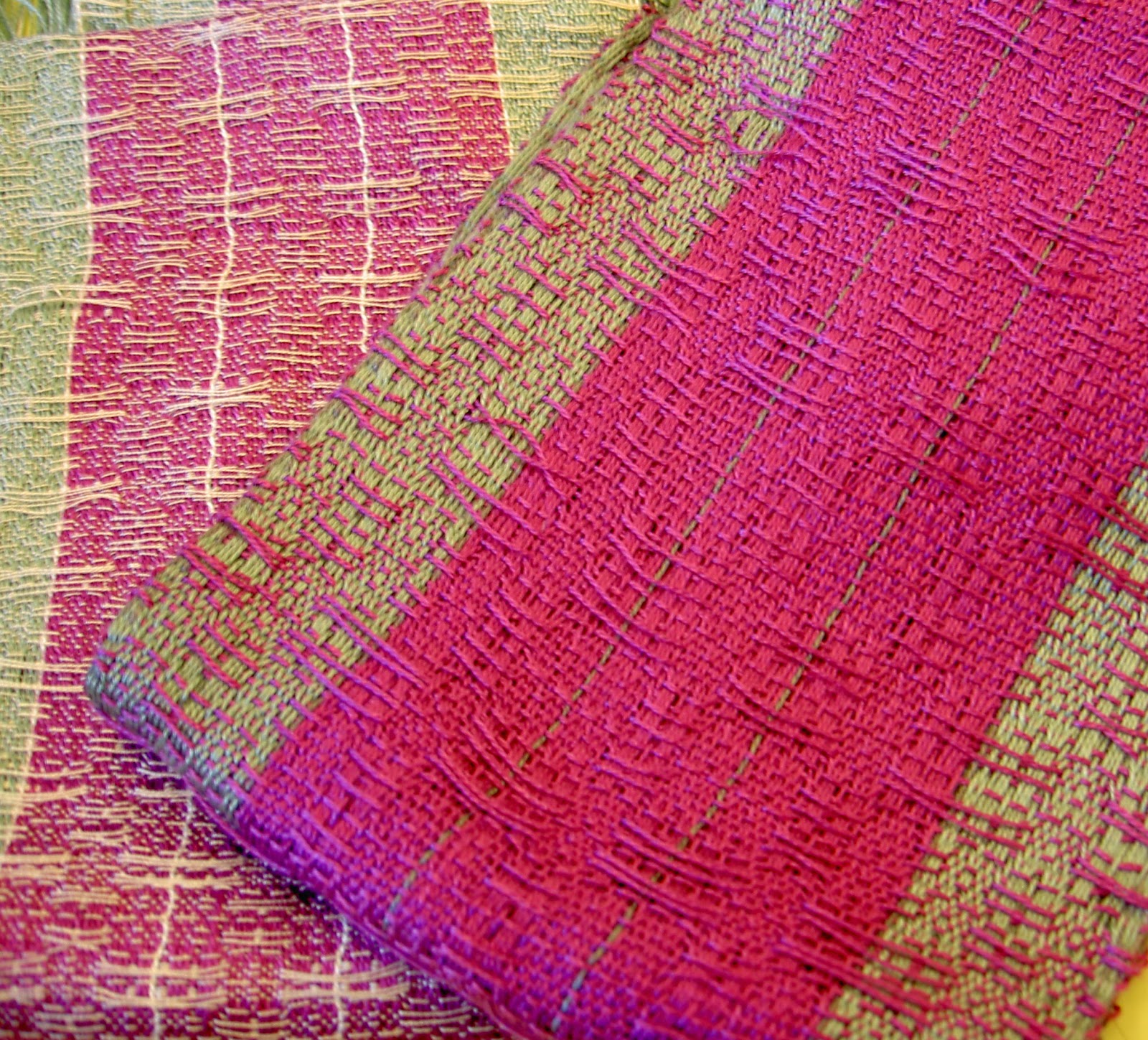
Cotton and Bamboo throw woven by Wendy Szpindel. Pattern from 8 Shaft Weaves book. 
Learning to weave and weaving requires a number of factors and environmental conditions. One is an environment that enables us to focus on the task at hand. Many weave structures are complicated and require ones full attention, the above being a good example of the kind of weave that requires this. Regardless of its complexity, most weaving requires that we not be distracted from what we are doing to prevent errors in threading and/or weaving. Not only does this require a certain capacity to concentrate, it requires that distractions are reduced and that we give the task the full attention. 
Knitters loom scarf by Mimma Draga
Last week I was talking to a couple of friends and they exclaimed that they were losing focus and were easily distracted. Is it an ageing thing I wonder or are we reverting to the child we were in the past? Who is to say. I do know though that we must respect that each person has different levels of "distraction tolerance" and so, when in a learning environment it is something we must try to respect in creating a positive learning and weaving environment for our fellow participants. 

Felted spaced warp merino scarf by Marion Kirkwood. This idea can be done on a Knitters Loom. 
Not too long ago someone was telling me about a couple of workshop teachers who insisted on silence during the workshop, that is to say, socializing. I found this very courageous of them to insist on that.  While I find that extreme, I also think it tells us that the learning and environment conducive to learning must take precedence in the class as most participants attend for that reason, otherwise, why pay to be there or socialize. We all have different learning needs, and perhaps participants also have different reasons they attend the class, but most importantly, we must remain focused on why we are here, gathered together!
More knitters loom scarves by Mimma Draga
I take pride though that participants for the most part, are friendly and this too creates  a positive environment. It takes all of us to create not only a friendly and positive environment but one where we respect the learning needs of others. 

Weaving Courses and workshops
Donna Kim is offering a new class in chair cane weaving. Looks interesting and intriguing!

Donations wanted:
Erin Lewis would like to ask weavers for their woven discards. She needs them for experimentation with her Wearable Technology work. Please bring to the Toronto Weaving School. 

Want to sell some scarves?
Bring them to the Toronto Weaving School classroom and we'll try to sell them for you as long as you are registered in the class. 10% of sales will go to the Toronto Weaving School. You can also bring in other small handwoven items such as tea towels and hand towels. We'll let people know that we are open for business on the days/evenings classes are running. 

Weaving Looms for Sale: 
45" 4 harness counterbalance leclerc with bench $500. 
36" 8 harness Leclerc jack loom $600. 
45" Schact loom with bench, oak, 4 harness with option to add another 4 harnesses. $750.
contact Line at tapestryline@sympatico.ca. 

Thursday, October 17, 2013

Patterns

Twill plaid blanket woven with Lemieux yarn by Judite Vagners. 
Recently I've been reading book The Philosopher, The Priest and the Painter: A Portrait of Descartes by Steven Nadler. Rene Descartes was a philosopher and mathematician and though born in France, lived for great lengths of time in the Netherlands. He is best known for the phrase: "I think therefore I am." Why, you might ask, would I bring that up, in my weaving class blog? As it turns out, there are a couple of reasons and one of them is his connection to Haarlem in the Netherlands. "Haarlem's economy [in 1646] was dominated by the textile industry, especially the finishing stages of production. The broad fields extending southwest of the city were used for the bleaching of fabrics. They served not only local manufacturers, but also foreign firms. Bolts of linen - woven by the thousands of textile workers employed in Haarlem or on looms in London or Scotland, and carried by boat across the English Channel - were first soaked in lye and then bathed for days in buttermilk supplied by surrounding dairies. They were then laid out in long stretches on the grasslands beyond the city's moat to dry and whiten in the sun from the late spring though the early fall. " 
Samples for the blanket above. First sample on left, the fabric just off the loom; middle sample washed; and final sample brushed. The result is soft blanket - a complete transformation of the yarn which at first seems hard and wiry. Instructions for this method available in class. 

As a philosopher and mathematician, Descartes was concerned with applying mathematical methods, strategies or patterns to our thought processes and observations. He believed that thinking required a certain methodology which we can apply to many parts of our lives, from our relationships, to our jobs and leisure activities, and of course weaving. There are many meanings and connotations for the word pattern but the ones I want to focus on most are that the references to our own patterns of thought and patterns of behavior based on the structures of our beliefs. As we see in weaving, patterns are directly related to the how the structure is organized and this will contribute to the overall patterning of the weft threads and resulting fabric. These ideas about patterns of thoughts and behaviors directly impact our relationships and the quality of our lives. We are each individually the master weaver of our lives. 

Huck Pattern bamboo scarf by Marion Kirkwood.

A couple of recent discussions are fresh in my mind. One is my sharing with some students my ongoing belief that weaving for me, has always been about a "healing journey" and though I have not been that vociferous about proclaiming it, I know that the moment I think the journey is about something else, for instance, about ego, pride and achievement or even intelligence ..some event arises to remind me about the real reason I weave, or have to weave. Often this  event may  humble me or leaves me feeling vulnerable. Sharing this opened the door for a friend to reveal that she saw weaving as a metaphor for life, an activity that mirrors what we are going through, our explorations to make new 'patterns' in our life, find new routes, new methodologies, new routines, new connections that will revitalize us. Somehow this weaving methodology does lead to transformation on a personal inner and outer level. I am mindful of it in myself and I clearly observe it happening in those that surround me and are part of this wonderful practice. 
Agota Dolinay (holding the tablet and looking down) and Ellen Alias are back from there 3 week journey in Peru where they studied tapestry weaving with Maximo Laura. The tapestries they completed were based on Maximo's 'patterns' (designs) and learned the Peruvian methodology of tapestry execution. It is very textural and each colour area uses 5 strands of  a fine alpaca. Agota, Ellen and Mai-Liis showed us their pictures and samples. 

Which leads me to the conclusion of my meandering but first....isn't it neat how synchronicity has been working these last few weeks and how each interaction with you and whatever is going on in my life seems to be so connected. Christine Shipley sent me this link to a blog entitled "Work is not  a job": http://workisnotajob.com/en/about. On the same theme, of changing life patterns, HGTV is looking for people who are doing just that: 
Fed up with the daily grind? Ready to give up your Wall Street corner office to run the corner cafe on Main Street? How about trading in that cubicle for a houseboat? Want to run your own B&B, rafting business, ski lodge, doggie daycare? Then HGTV is looking for you! HGTV’s, latest series, new house, new life seeks fun, high-energy, people who are in the process of flipping their career or current status for a lifelong passion or newfound interest and moving from their current digs to their dream home! Our cameras will be there to capture key milestones: The trials and tribulations of career departures, moving, settling into new environments, wrangling unexpected surprises with family, realtors and colleagues as the dream becomes a reality. Getting from point a to point b promises multiple surprises and unpredictable finales. Casting applications are being accepted now and production will continue through the fall. Ideal candidates will be outgoing, financially candid people who would love to share their life-changing experience with HGTV’s audience; inspiring others to pursue their dreams too. Singles, couples and families are all invited to apply! For more information please contact:bschoede@orionentertainment.com720.891.4860

Exhibitions
Sacred Stitches
Beauty and Holiness in
the Needlework of many faiths
A week long exhibit of textile art
to mark the 100th anniversary of
Ecclesiastical Needleworkers
of the Diocese of Toronto
Friday October 25-Friday Nov. 1, 2013
at St. James Cathedral, 7:00 am -7:pm
65 Church St. & King St. E. Toronto

Community Threads Exhibition
12 tapestries depicting community life recently woven by the Nottawasaga Weavers and Spinners to be exhibited in Alliston, Ontario. Be supportive of other weavers and join me at the opening reception Sunday October 27 between 2-5pm. Refreshments are served!
The Gibson Centre
63 Tupper Street West
Alliston.

Christmas and Cedar Ridge
Sunday November 10
12-5pm
Cedar Ridge Creative Centre
225 Confederation Drive
Scarbourough Ontario

Talks, Workshops & Call for Entries
Karen Bota let us know about a rug weaving event happening at the Textile Museum of Canada: 
http://www.textilemuseum.ca/microsites/artdayproject/ArtDayProject.html

Stitches across TimeDeadline: April 14, 2014
Dufferin County Museum & Archives
936029 Airport Road, Mulmur, ON

September 12 - November 9, 2014
Dufferin County Museum & Archives is pleased to once again present the exhibition Stitches across Time in 2014. Continuing the theme of the first exhibit in 2011, the exhibition will celebrate the tradition and history of textile arts. The DCMA invites submissions for a national juried exhibition of fibre art works inspired by a new selection of six historical pieces from the museum’s extensive collection of textile artifacts.

For access to the call for entry and to view the six inspirational images go towww.stitchesacrosstime.com. For further information email Ruby Qureshi:events@dufferinmuseum.com.

Thursday, October 10, 2013

Role models and mentors

Recently, a friend mentioned how inspired she was by a talk Andrea Graham gave entitled "Paddle your own Canoe". http://www.andrea-graham.com/about.html.  Already this young woman has had incredible success in every area of her life it seems, but especially...and enviably, as a fibre artist, more than most  will ever achieve regardless of how much they strive. All her circumstances seem to have conspired to create the incredible opportunities and creative life she has. 
Picture taken by a friend of Darryn Crombeen, while visiting Thailand. These people dyed the silk and wove it. 

In the news here in Toronto recently, an 89 year old peace activist by the name of Audrey Tobias won her court case for refusing to fill out a federal census form, because "Lockheed Martin , the American arms manufacturer, .....provided the software Statistics Canada used to process the information. Tobias said the publicity of last week’s one-day trial pleased her.....“I wanted to make the point that our government is on the wrong path, vis-à-vis the way it handles its military and defence,” Tobias said. “Do you think I made that point? I think I did. http://www.thestar.com/news/crime/2013/10/09/audrey_tobias_89yearold_census_refuser_to_find_out_fate_wednesday.html
 Karin Domnick, a recent arrival to our weaving class, has had many weaving adventures. Here one in Mexico. 

This connects with a review I read recently of Malcolm Gladwell's newly released book, David and Goliath. 
"In David and Goliath, Malcolm Gladwell, with his unparalleled ability to grasp connections others miss, uncovers the hidden rules that shape the balance between the weak and the mighty, the powerful and the dispossessed. Gladwell examines the battlefields of Northern Ireland and Vietnam, takes us into the minds of cancer researchers and civil rights leaders, and digs into the dynamics of successful and unsuccessful classrooms–all in an attempt to demonstrate how fundamentally we misunderstand the true meaning of advantages and disadvantages. When is a traumatic childhood a good thing? When does a disability leave someone better off? Do you really want your child to go to the best school he or she can get into? Why are the childhoods of people at the top of one profession after another marked by deprivation and struggle?" 
Karin Domnick, a silversmith, also visited this Japanese weaver on her travels. 
The subject came up yet again when I was driving a couple of weaving students to the subway. One mentioned that she was sent a link about a contest of sorts to win a spot to be mentored for a weaving experience. http://www.youtube.com/watch?v=gHjvzOEbWd8&feature=youtu.be
It doens't matter how old we are, we naturally seek out people, usually older than us and often more experienced, that for us represent how we want to live our lives, and the kind of people we want to shape ourselves to be. Audrey is definitely on my list , and there are many women her age that  inhabit my list along with her. Somehow they've maintained a vitality, still have ideals and qualities that I admire. Somehow, they've managed to live  a life that is true to themselves, that is authentic and not prescribed. They are my role models and offer me other ideas about how to live ones life. More recently, I see that I too am a mentor for other women....some younger, some not. It doesn't matter where one is along that continuum, of seeking to live an authentic, and meaningful life, we need to be able to envision what that looks like, what it sounds like, what it feels like.....we need to examine every dimension of our lives and remove all that is not enabling us to reach our 'best self' as Oprah would say. When we don't live the kind of life we envision for ourselves, we start to feel that ache inside and a sense that we are not truly living our lives, but only going through the motions described by the parameters of societal and family expectations. In short, it takes courage to live that kind of life because we must risk: risk looking like a fool, of failing...of not always being certain of what the outcomes will be and where our choices will lead us, but it's even riskier to one's well being if you don't take the risk at all. I may not achieve or accomplish all that I aspire, but I sure will try. 
Arlette Schulman submitted this tapestry woven shape for the international tapestry project. 
I find this theme connects also with Fate, Destiny and Self-Determination/le sort, destin et l'auto-determination international tapestry project that I have undertaken. Fate is defined as a force, energy, principle, element or power that prescribes to each person a set of limits, boundaries and confines. In Islam it is called Kismet.The Greeks called Fate, Moira. Greek Mythology speaks of the three Fates: Clotho, Lachesis and Atropos who supposedly controlled each person’s fate. The youngest, Clotho,  is a spinner and she determines the time of birth and spins the thread of life on her distaff. Lachesis measures the length of the thread to determine the length of one’s life; the time of death is decided by Atropos, who cuts the thread. Inherent in the idea of Fate, is that one has no influence over events and outcomes. Mythology and psychology distinguish between Fate and Destiny. Destiny, is considered an expanding field of possibilities alluding to our potential to influence our Fate. This makes Destiny kinetic. “The lives we construct are an inextricably woven fabric of influences, possibilities and accumulated consequences of choices made.” (What Matters Most, James Hollis). You are never too old and it is never too late to make your life into what you want it to be.

Sunday, September 29, 2013

Questioning my competency as a Teacher

Christine Shipley, Theo Moorman scarf, based on my design in Handwoven Summer 2013. Christine tried the tie up and treadling that Handwoven had changed from my own original plan and she found it worked out fine, much to our relief. 

A new term of weaving classes has begun, and the first thing that struck was how happy and enthusiastic  as well as loud and boisterous students have been in the class, communicated by the volume at which they spoke, at times making it difficult for me to be heard and to teach. I wondered if I was a good teacher at this point, thinking that I had lost complete control over my class! LOL! So questioning my own competency I started reading some research about creating good learning environments and I came upon “Constructivist Learning Environments” by  Brent G. Wilson and what I learned is that this is all a very good sign!

Christine Shipley, clasp weave scarf with chenille and tencel. 
I was very relieved to hear what he had to say and what he considered to be good learning environments . The role of  the teacher in his view is one where lerning is fostered  and supported, but not controlled or dictated in any strict fashion.  He talks about the difference between ‘instructional environments’ and  ‘learning environments’. ... a learning environment is one in which  learning is fostered and supported, as opposed to an instructional environment, that is a more controlled and directive of the students activities and interactions.  To someone observing the class, a ‘learning  environment’ appears chaotic  (which it certainly does in our class!), however this only indicates that the environment is  dynamic, responsive and vibrant. This approach sees the student taking more initiative in their learning and leaving the teacher to take a back seat, perhaps guiding, advising and encouraging rather than being directive.  The teacher is responsive to each individual student as they work at their own rhythm and decide individually what direction they want to take and what kind of challenges they are ready to take on.
Louise Granahan, houndstooth scarf in bamboo (rayon). Louise takes all her design ideas from the beginner sampler she did with us. 
The idea of creating a ‘learning community’ is definitely what is happening in our classroom at the Toronto Weaving School, where students are eager to help each other on projects and inspire others with the projects they have done. The students support each others learning constantly...it’s a real environment of cooperation and caring.  Thus creating a good ‘learning environment’ is one in which learners have at their disposal the tools, equipment, and resources that are complemented by the impact other people in the learning environment have upon each other.  So I guess I am now convinced that I have intuitively created an optimum learning environment for weaving, thanks to you and your lively participation. In all of this I only ask that you not forget and include the newcomers to the class .....
Marion Kirkwood. Atwater Bronson Lace Scarves adapted from Handwoven Mar/April 2008, p 54-56 8 shaft pattern. Tencel (rayon). 

I featured Nieves Carresco last week and she wrote to me this week and said:
"Good morning Line, a quick note to let you know that we went to see the textile show on Gerrard a couple of days ago with Pascal. I immediately recognized your pieces! My favourite is "Around in Circles", with the loose and apparently random positioning of these yarns but obviously following some sort of structure. Your colour palette is very appealing, refreshing, optimistic. A really delightful piece. I also liked the fine grid of the background. I saw your blog also, thank you for including me! About Jun Tomita, you made the same mistake I made .... Jun is a man (not a woman), and actually his wife is also an artist, I believe, but I'm not sure what her role is in his studio (as you can see from the web page, almost all is in Japanese!)"
You sent me: 
Scott Ford  thought that this would be of interest to weavers: http://www.leevalley.com/en/newsletters/Gardening/8/9/Letter.htm

Louise Granahan (sorry....info lost on this scarf). 

Friday, September 20, 2013

See a project to the finish

Bonnie Thorne created this linen hand towel. Her struggles and frustrations with this project payed off and she now is glad she didn't 'throw in the towel'  on this one. It was stiff and rigid before she washed it, and it transformed into soft and supple.  Plain weave ground with twill variation treadling for the blue design. 

The warp for this scarf is baby llama and silk and the weft is alpaca. Marion Kirkwood used a M&W threading from Handweavers Pattern Directory, p 76. 
This has been a very interesting week. Last Friday I had coffee with Nieves Carrasco, a fibre artist who uses washi cut into fine strips and weaves them into wall hangings. It was a real treat to see her work in her living/work space. She is presently getting ready for her show at the David Kaye gallery which will be this coming February. To see more of her work go to http://www.nievescarrasco.com/home.html.
My friends, Maurice Poon from York University and Scott Ford from Hydro One weaving on the international tapestry project, Fate, Destiny and Self-Determination. 

My first weaving teacher, William Hodge, is having a show of his recent bead work. Details on this invite. The opening is this Sunday. 

Interesting weaving links you've sent
Jessica Brousseau sent this link to let us know that 70s style wallhangings are becoming the trend again: http://allroadsdesign.com/

My sister, Rita sent me this link about jacquard weaving in France after I had been to Fondazione Lisio: http://www.maisondescanuts.fr/

Arlette Schulman, herself a tapestry weaver,  was inspired by this fibre artist and sent me this link: http://www.worldofthreadsfestival.com/artist_interviews/095_mackenzie_frere_13.html

Sandra Dunn wanted to recommend Sandra Brownlee Ramsdale's jacquard weaving that was exhibited at the Textile Museum of Canada: http://www.textilemuseum.ca/apps/index.cfm?page=exhibition.detail&exhid=169

Nieves Carrasco was inspired by this woman's work: http://www.juntomita.com/Jun_Tomita_-_Textile_Studio/Top.html

Thursday, September 12, 2013

Fondazione Arte della Seta Lisio


The Duomo in Florence, Italy
This past June I had the privilege of travelling to Florence to take a one week workshop at the Fondazione Arte della Seta Lisio. There were only three students - myself and...shown below on the right...Abbas Kahn from India and Georgia Hughes from England.....
and two very knowledge, flexible and accommodating  teachers - left to right - Julie Holyoke and Eva Basile. Julie has recently authored a book, Digital Jacquard Design to be released in the UK in October 2013, and in North America in December 2013. My main goal was to become familiar with the whole process as I am an experiential learner 
From the moment I walked into the Fondazione Arte della Seta Lisio, I felt it was a great honour to be there and to see these remarkable jacquard  looms in operation, along with being surrounded by all its history, tradition and its heritage.   I was even more astounded that I had a chance to weave on them. Lisio has created fabrics for many powerful and wealthy individuals and for theatre and movie sets. 
Lisio created the fabric for Elizabeth Taylor's dress for the movie the Taming of the Shrew. 
Gian Paoulo Cerchiarini weaving a voided velvet. 
It required a certain amount of physical effort to weave with the ‘manual’ jacquard loom. This gave me greater appreciation for the work it took to weave velvet, both in preparing the cards and the weaving of it.
Velvet requires a minimum of 2 warps. Here we see the second warp (the one used to create the pile in velvet) and how each thread is attached to a spool. It required a certain amount of physical effort to weave with the ‘manual’ jacquard loom. Until  1990 the Telaio Serenissima had been in storage for 20 years and it took the Fondazione four months to restore it.  It had originally been used by Giuseppe Lisio (the founder) in 1925 for the production of 3 warp velvet, the most highly prized fabric made by Lisio. It has 12,000 silk warp threads, 2000 punch cards and while I was there, the punch cards were being prepared for a new design, shown below.


Velvet was not the only think being woven at Lisio. Here Marta Valdarni weaves what is called a Cloth of Gold (and Silver), highly prized during the Renaissance and still highly esteemed in liturgical communities. These kinds of textiles are used to create garments for priests, bishops, cardinals and Popes of the Roman Catholic Church (and quite possibly other religions).
Each shuttle weaves either a gold or silver sun shape, and are worked individually, like a tapestry technique. In between each row of pattern show, 3 to 4 rows of background weft are woven. Marta's loom was powered and she used a flying shuttle.
I created my own design for the jacquard loom shown here. Eva helped me each step of the way. By the middle of the week I was done and ready to experience the powered jacquard loom.  We selected an image from my files and we again went through the process of preparing the point sheet on the computer, but this time, no cards were required. The software would allow us to weave the design directly. I worked with a flying shuttle for the first time and I loved it. Each weft was programmed and pressing on the powered pedal raised the correct threads in the warp to create the image.
After my course I went to the Uffize gallery, the Pitti Palace, the Costume gallery....where I saw many paintings that painstakingly rendered the rich and sumptuous textiles (velvets, damasks, gros de tour etc) of the period and from which Lisio took his inspiration. In this portrait of Eleonore of Toledo with son Giovanni by Bronzino, one feels you can almost touch the actual velvet. Every loop, every pile and the glistening of the silk seems so real. Many other painters such as Gusto Sustermans, Van Dyck, Titian, Rubens, Rafael, Signorelli, abd Botticelli to name a few, also rendered textiles superbly and convincingly. 
I was awestruck by this sculptured detail of a fabric (damask) in a monument in Sta Croce, the church that has many tombs and monuments to great thinkers and innovators of every domain.

In closing I am hoping to return and bring with me other students who want to share this unique and inspiring experience. A maximum of 5 to 6 students at a time and the workshops will be offered in the summer. If you think you are interested contact me (Line Dufour) at tapestryline@sympatico.ca.


Tuesday, August 13, 2013

Weaving Class Registration and more

Eleonor of Toledo with her son Giovanni, painted by Bronzino. This painting hangs in the Uffizi and the voided silk velvet fabric  of the dress is an example of the kinds of textile reproductions that the Fondazione Lisio creates. 
.

I visited the Uffizi when I was in Florence in June. Above all I was dazzled by the virtuosity and skill of several painters in their ability to depict textiles in minute detail. Of course, those who commissioned these portraits were proud to display their status which was conveyed by the textiles they were adorned with. Bronzino was in my estimation, one of the most talented artists in this regard. Despite her initial unpopularity with the Florentines as Cosimo I's consort,  and  as a Spaniard, Eleonor gained great influence in Florence. She encouraged the arts and was patron to many of the most notable artists of the age. A pious woman, she encouraged the Jesuit order to settle in Florence, founded many new churches in the city and attempted to better the lot of the peasantry. It is said that as many as 10 "cloth of gold and silver" weavers were in her employ creating the textiles for her wardrobe requirements. 

Toronto Weavers and Spinners asked me to give a talk and slide presentation of my recent stay in Florence Italy describing the experience of taking a one week jacquard weaving workshop at the Fondazione Arte della Seta Lisio, with the two instructors Eva Basile and Julie Holyoke. I will describe the processes involved in creating jacquard woven textiles. The talk will take place Wednesday September 11 at Riverdale Farm at 7:00 pm. If you need instructions about where it is located please contact me at tapestryline@sympatico.ca. 
Summer and winter table runner by Renata Lindner. 
Pattern taken from the book Handweavers Pattern Directory by Ann Dixon. 

Registration for weaving classes in fabric, rug and tapestry  commences August 12, 2013. 
Monday classes begin September 16 and run until December 2. 
Wednesday classes begin September 18and run until November 27.  
Black tencel scarf by Dr. Louise Granahan

The cost for the Senior rate 61 years of age and older is $140 and below 61- Adult -  $234. 
Here are the code numbers for each of the classes which you will need to enter if you register on-line through this link: 


Monday 10-1                  61212
Monday 1:30-4:30          61211
Monday 6-9pm               62300
Wednesday 10-1            61210
Wednesday 1:30-4:30    61639
Wednesday 6-9pm         62301

Note:  Wednesday 1:30-4:30 is a considered a Seniors Daytime class. When you arrive at this page click on the Seniors Daytime. Note that only 2 non-seniors can register in this time slot. If you are a non-senior, can only come in this time slot and are unable to register, please contact me directly at tapestryline@sympatico.ca. 
Scarf in Theo Moorman technique based on my design in summer 2013 issue of Handwoven magazine. Woven by Judite Vagners.