Sunday, September 29, 2013

Questioning my competency as a Teacher

Christine Shipley, Theo Moorman scarf, based on my design in Handwoven Summer 2013. Christine tried the tie up and treadling that Handwoven had changed from my own original plan and she found it worked out fine, much to our relief. 

A new term of weaving classes has begun, and the first thing that struck was how happy and enthusiastic  as well as loud and boisterous students have been in the class, communicated by the volume at which they spoke, at times making it difficult for me to be heard and to teach. I wondered if I was a good teacher at this point, thinking that I had lost complete control over my class! LOL! So questioning my own competency I started reading some research about creating good learning environments and I came upon “Constructivist Learning Environments” by  Brent G. Wilson and what I learned is that this is all a very good sign!

Christine Shipley, clasp weave scarf with chenille and tencel. 
I was very relieved to hear what he had to say and what he considered to be good learning environments . The role of  the teacher in his view is one where lerning is fostered  and supported, but not controlled or dictated in any strict fashion.  He talks about the difference between ‘instructional environments’ and  ‘learning environments’. ... a learning environment is one in which  learning is fostered and supported, as opposed to an instructional environment, that is a more controlled and directive of the students activities and interactions.  To someone observing the class, a ‘learning  environment’ appears chaotic  (which it certainly does in our class!), however this only indicates that the environment is  dynamic, responsive and vibrant. This approach sees the student taking more initiative in their learning and leaving the teacher to take a back seat, perhaps guiding, advising and encouraging rather than being directive.  The teacher is responsive to each individual student as they work at their own rhythm and decide individually what direction they want to take and what kind of challenges they are ready to take on.
Louise Granahan, houndstooth scarf in bamboo (rayon). Louise takes all her design ideas from the beginner sampler she did with us. 
The idea of creating a ‘learning community’ is definitely what is happening in our classroom at the Toronto Weaving School, where students are eager to help each other on projects and inspire others with the projects they have done. The students support each others learning constantly...it’s a real environment of cooperation and caring.  Thus creating a good ‘learning environment’ is one in which learners have at their disposal the tools, equipment, and resources that are complemented by the impact other people in the learning environment have upon each other.  So I guess I am now convinced that I have intuitively created an optimum learning environment for weaving, thanks to you and your lively participation. In all of this I only ask that you not forget and include the newcomers to the class .....
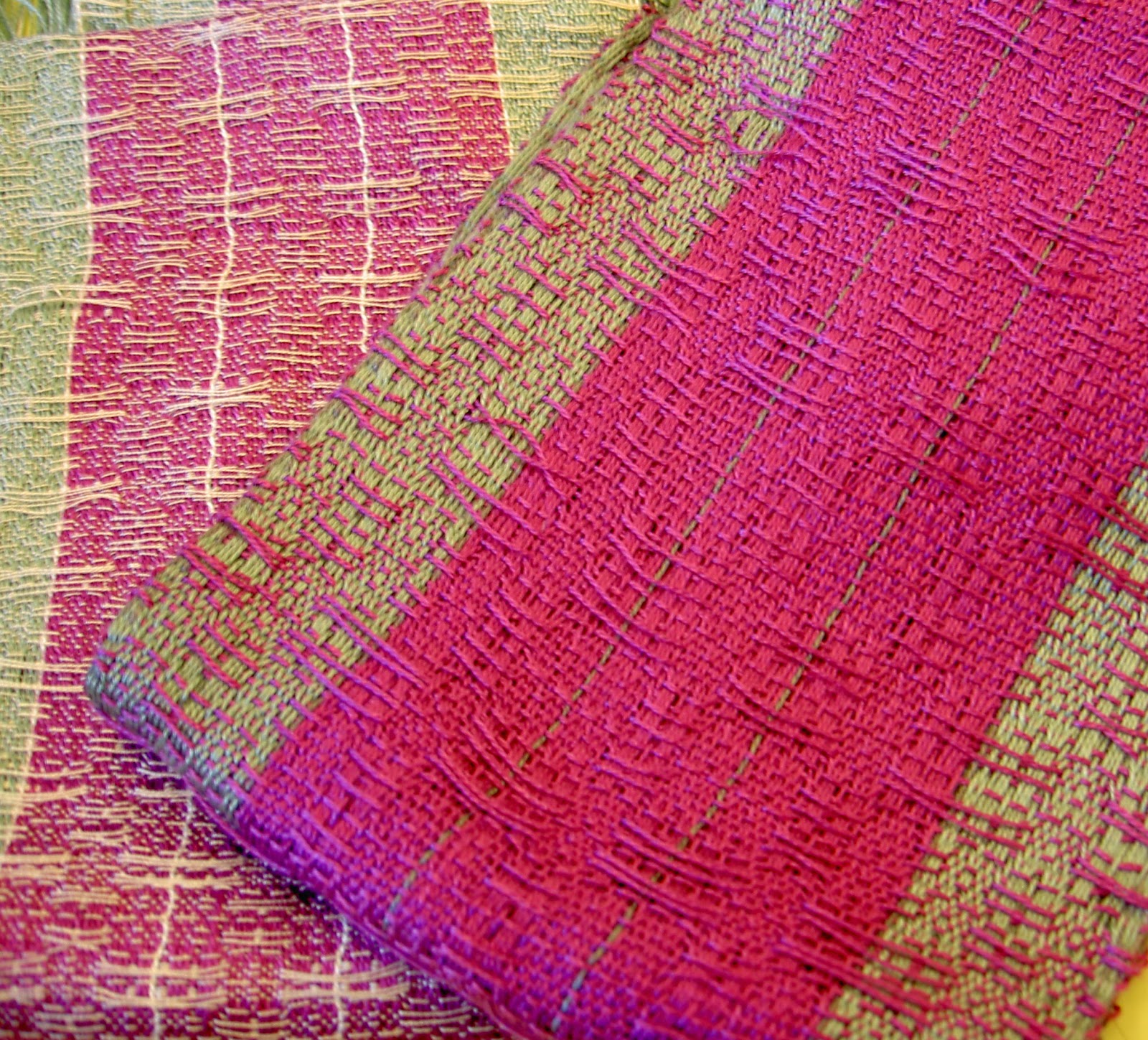
Marion Kirkwood. Atwater Bronson Lace Scarves adapted from Handwoven Mar/April 2008, p 54-56 8 shaft pattern. Tencel (rayon). 

I featured Nieves Carresco last week and she wrote to me this week and said:
"Good morning Line, a quick note to let you know that we went to see the textile show on Gerrard a couple of days ago with Pascal. I immediately recognized your pieces! My favourite is "Around in Circles", with the loose and apparently random positioning of these yarns but obviously following some sort of structure. Your colour palette is very appealing, refreshing, optimistic. A really delightful piece. I also liked the fine grid of the background. I saw your blog also, thank you for including me! About Jun Tomita, you made the same mistake I made .... Jun is a man (not a woman), and actually his wife is also an artist, I believe, but I'm not sure what her role is in his studio (as you can see from the web page, almost all is in Japanese!)"
You sent me: 
Scott Ford  thought that this would be of interest to weavers: http://www.leevalley.com/en/newsletters/Gardening/8/9/Letter.htm

Louise Granahan (sorry....info lost on this scarf). 

Friday, September 20, 2013

See a project to the finish

Bonnie Thorne created this linen hand towel. Her struggles and frustrations with this project payed off and she now is glad she didn't 'throw in the towel'  on this one. It was stiff and rigid before she washed it, and it transformed into soft and supple.  Plain weave ground with twill variation treadling for the blue design. 

The warp for this scarf is baby llama and silk and the weft is alpaca. Marion Kirkwood used a M&W threading from Handweavers Pattern Directory, p 76. 
This has been a very interesting week. Last Friday I had coffee with Nieves Carrasco, a fibre artist who uses washi cut into fine strips and weaves them into wall hangings. It was a real treat to see her work in her living/work space. She is presently getting ready for her show at the David Kaye gallery which will be this coming February. To see more of her work go to http://www.nievescarrasco.com/home.html.
My friends, Maurice Poon from York University and Scott Ford from Hydro One weaving on the international tapestry project, Fate, Destiny and Self-Determination. 

My first weaving teacher, William Hodge, is having a show of his recent bead work. Details on this invite. The opening is this Sunday. 

Interesting weaving links you've sent
Jessica Brousseau sent this link to let us know that 70s style wallhangings are becoming the trend again: http://allroadsdesign.com/

My sister, Rita sent me this link about jacquard weaving in France after I had been to Fondazione Lisio: http://www.maisondescanuts.fr/

Arlette Schulman, herself a tapestry weaver,  was inspired by this fibre artist and sent me this link: http://www.worldofthreadsfestival.com/artist_interviews/095_mackenzie_frere_13.html

Sandra Dunn wanted to recommend Sandra Brownlee Ramsdale's jacquard weaving that was exhibited at the Textile Museum of Canada: http://www.textilemuseum.ca/apps/index.cfm?page=exhibition.detail&exhid=169

Nieves Carrasco was inspired by this woman's work: http://www.juntomita.com/Jun_Tomita_-_Textile_Studio/Top.html

Thursday, September 12, 2013

Fondazione Arte della Seta Lisio


The Duomo in Florence, Italy
This past June I had the privilege of travelling to Florence to take a one week workshop at the Fondazione Arte della Seta Lisio. There were only three students - myself and...shown below on the right...Abbas Kahn from India and Georgia Hughes from England.....
and two very knowledge, flexible and accommodating  teachers - left to right - Julie Holyoke and Eva Basile. Julie has recently authored a book, Digital Jacquard Design to be released in the UK in October 2013, and in North America in December 2013. My main goal was to become familiar with the whole process as I am an experiential learner 
From the moment I walked into the Fondazione Arte della Seta Lisio, I felt it was a great honour to be there and to see these remarkable jacquard  looms in operation, along with being surrounded by all its history, tradition and its heritage.   I was even more astounded that I had a chance to weave on them. Lisio has created fabrics for many powerful and wealthy individuals and for theatre and movie sets. 
Lisio created the fabric for Elizabeth Taylor's dress for the movie the Taming of the Shrew. 
Gian Paoulo Cerchiarini weaving a voided velvet. 
It required a certain amount of physical effort to weave with the ‘manual’ jacquard loom. This gave me greater appreciation for the work it took to weave velvet, both in preparing the cards and the weaving of it.
Velvet requires a minimum of 2 warps. Here we see the second warp (the one used to create the pile in velvet) and how each thread is attached to a spool. It required a certain amount of physical effort to weave with the ‘manual’ jacquard loom. Until  1990 the Telaio Serenissima had been in storage for 20 years and it took the Fondazione four months to restore it.  It had originally been used by Giuseppe Lisio (the founder) in 1925 for the production of 3 warp velvet, the most highly prized fabric made by Lisio. It has 12,000 silk warp threads, 2000 punch cards and while I was there, the punch cards were being prepared for a new design, shown below.


Velvet was not the only think being woven at Lisio. Here Marta Valdarni weaves what is called a Cloth of Gold (and Silver), highly prized during the Renaissance and still highly esteemed in liturgical communities. These kinds of textiles are used to create garments for priests, bishops, cardinals and Popes of the Roman Catholic Church (and quite possibly other religions).
Each shuttle weaves either a gold or silver sun shape, and are worked individually, like a tapestry technique. In between each row of pattern show, 3 to 4 rows of background weft are woven. Marta's loom was powered and she used a flying shuttle.
I created my own design for the jacquard loom shown here. Eva helped me each step of the way. By the middle of the week I was done and ready to experience the powered jacquard loom.  We selected an image from my files and we again went through the process of preparing the point sheet on the computer, but this time, no cards were required. The software would allow us to weave the design directly. I worked with a flying shuttle for the first time and I loved it. Each weft was programmed and pressing on the powered pedal raised the correct threads in the warp to create the image.
After my course I went to the Uffize gallery, the Pitti Palace, the Costume gallery....where I saw many paintings that painstakingly rendered the rich and sumptuous textiles (velvets, damasks, gros de tour etc) of the period and from which Lisio took his inspiration. In this portrait of Eleonore of Toledo with son Giovanni by Bronzino, one feels you can almost touch the actual velvet. Every loop, every pile and the glistening of the silk seems so real. Many other painters such as Gusto Sustermans, Van Dyck, Titian, Rubens, Rafael, Signorelli, abd Botticelli to name a few, also rendered textiles superbly and convincingly. 
I was awestruck by this sculptured detail of a fabric (damask) in a monument in Sta Croce, the church that has many tombs and monuments to great thinkers and innovators of every domain.

In closing I am hoping to return and bring with me other students who want to share this unique and inspiring experience. A maximum of 5 to 6 students at a time and the workshops will be offered in the summer. If you think you are interested contact me (Line Dufour) at tapestryline@sympatico.ca.


Tuesday, August 13, 2013

Weaving Class Registration and more

Eleonor of Toledo with her son Giovanni, painted by Bronzino. This painting hangs in the Uffizi and the voided silk velvet fabric  of the dress is an example of the kinds of textile reproductions that the Fondazione Lisio creates. 
.

I visited the Uffizi when I was in Florence in June. Above all I was dazzled by the virtuosity and skill of several painters in their ability to depict textiles in minute detail. Of course, those who commissioned these portraits were proud to display their status which was conveyed by the textiles they were adorned with. Bronzino was in my estimation, one of the most talented artists in this regard. Despite her initial unpopularity with the Florentines as Cosimo I's consort,  and  as a Spaniard, Eleonor gained great influence in Florence. She encouraged the arts and was patron to many of the most notable artists of the age. A pious woman, she encouraged the Jesuit order to settle in Florence, founded many new churches in the city and attempted to better the lot of the peasantry. It is said that as many as 10 "cloth of gold and silver" weavers were in her employ creating the textiles for her wardrobe requirements. 

Toronto Weavers and Spinners asked me to give a talk and slide presentation of my recent stay in Florence Italy describing the experience of taking a one week jacquard weaving workshop at the Fondazione Arte della Seta Lisio, with the two instructors Eva Basile and Julie Holyoke. I will describe the processes involved in creating jacquard woven textiles. The talk will take place Wednesday September 11 at Riverdale Farm at 7:00 pm. If you need instructions about where it is located please contact me at tapestryline@sympatico.ca. 
Summer and winter table runner by Renata Lindner. 
Pattern taken from the book Handweavers Pattern Directory by Ann Dixon. 

Registration for weaving classes in fabric, rug and tapestry  commences August 12, 2013. 
Monday classes begin September 16 and run until December 2. 
Wednesday classes begin September 18and run until November 27.  
Black tencel scarf by Dr. Louise Granahan

The cost for the Senior rate 61 years of age and older is $140 and below 61- Adult -  $234. 
Here are the code numbers for each of the classes which you will need to enter if you register on-line through this link: 


Monday 10-1                  61212
Monday 1:30-4:30          61211
Monday 6-9pm               62300
Wednesday 10-1            61210
Wednesday 1:30-4:30    61639
Wednesday 6-9pm         62301

Note:  Wednesday 1:30-4:30 is a considered a Seniors Daytime class. When you arrive at this page click on the Seniors Daytime. Note that only 2 non-seniors can register in this time slot. If you are a non-senior, can only come in this time slot and are unable to register, please contact me directly at tapestryline@sympatico.ca. 
Scarf in Theo Moorman technique based on my design in summer 2013 issue of Handwoven magazine. Woven by Judite Vagners.  

Wednesday, June 12, 2013

Weaving in the middle of the Toronto Financial District

I read this article in the Sunday June 9 2013 Toronto Star. I thought it was just so fun......Thank you Johanns Zits for making weaving trendy with this art installation.


Thursday, June 6, 2013

Stylish Woven Floor coverings

Woven by Julia Pelenyi.
Julia took the design from Handwoven's September/October 2005 issue on page 67. The rug was designed by Mimi Smith.
Jill Bidgood
 Many of us have watched Jill slowly and meticulously work on this warp faced/repp weave rug. It was a while in getting the warp prepared, not only because one had to be careful with the constantly changing colours and their order, but also because the yarn she worked with had a lot of inconsistencies, which slowed her down considerably. She did a beautiful job of weaving these rugs. We'll get to see them in actuality when classes resume in the Fall.
Jill took the design from one of Ashford's magazines that come out bi-annually or annually....not sure about that! But the design is a classic and a keeper! I'm not organized enough at the moment to have the name of the person who created the design.....I hope the designer will accept my apologies.

Erin Lewis
Erin's rug is a bird's eye pattern taken from Marguerite Davison's Handweavers Pattern Book.
 
I found this interesting link about textiles and weaving with a lot of information to keep you learning for awhile:  http://www.textileasart.com/weaving.htm
 
That's it for this blog until the end of August where I will post the projects remaining from this past years endeavours at the Toronto Weaving School. The tapestry blog will continue and I will keep you posted about that. I'm off to take my jacquard weaving course in Florence and look forward as well to spending time in my studio.
 
I found

Thursday, May 30, 2013

Transformation

Placemats in plain weave by Avril Loretti.
Avril Loretti joined has her own thriving business creating her own printed tea towels, among other textiles for domestic use. She transformed remnants of her own printed fabrics and cut them into strips to create these placemants. To see her collection go to www.avrilloretti.com.

 Lis wove this Rosepath  baby blanket designed by Katie Bloomfield and the pattern was taken from Handwoven's Collection #14.
Many women like to weave baby blankets for their own children who are now having children. They get to witness the many transformations that their offspring go through, an ongoing and infinite process.
Simona Comenscu matches with her double weave wool blanket she is weaving and the site of her at the loom was a delightful site!
When Simona first came to our weaving classes last spring, she was jobless and eagerly looking to be gainfully employed. This year she found a job in an area that interests her and I've been witness to how the weaving and the job has transformed her in a positive way!
Susan Keslick
Last week I featured Lindsay Keslick's stair runners (green herringbone type pattern) and this week Lindsay brought in a butterfly woven on a floor loom in a bound weave or weft faced weave, similar to tapestry, made 35 years ago. It still has a contemporary feel to it and has stood the test of time. This butterfly is my theme this week, symbolizing transformation. As a weaving instructor at the Toronto Weaving School, I get to witness the personal transformations that many people go through because of or during their weaving learning. Life changes, job changes, new opportunities, new friendships,  births, illness and deaths. I see each person grow in their confidence to tackle their own weaving challenges and artisanal/artistic aspirations. I observe them getting bolder and undertaking more initiatives to promote themselves and their work, or to expand their learning and weaving practice.

Joan MacKenzie, a member of the Etobicoke Guild of Weavers and Spinners and a past student, visited the Toronto Weaving School to work on the international tapestry project, Fate, Destiny and Self Determination. She's working on her Master Spinner's certificate with the OHS and using her own handspun yarn, wove this scarf. The pattern is from Carol Stickler's A Weavers Book of 8 Shaft Patterns on page 87.
 
For our year end field trip, we visited the home and studio(s) of Pat Burns Wendland in Mulmur, Ontario. What a scenic drive and a great day. Pat showed us her work spaces, the garments she has woven, fabrics she has created and other smaller items she has woven. We had a great pot luck lunch!
 
I'll be off to Florence Italy to take a jacquard weaving course at the Fondazione Lisio. Here is a link to their site: http://www.fondazionelisio.org/ and will share with you my adventures there. Who knows how this will transform my own practice as a weaver and artist.
 
You might want to check out this exhibit at the Textile Museum of Canada:  Ancestry and Artistry: Maya textiles from Guatemala, http://www.textilemuseum.ca/apps/index.cfm?page=exhibition.detail&exhId=348 You might also be interested in this site: http://www.mayanhands.org/