Thursday, February 20, 2014

10 Weaving Lessons

My place in the weaving class is of course to teach weaving. But often registrants in the class have lessons that I take from them. This week the lesson that  stood out was that we're never too experienced (or conversely inexperienced) - lesson #1 . We're always  learning new things, reviewing old lessons, revisiting previous knowledge that might not be that helpful and replace it with new practices that deepen and enrich our weaving experienced. Judite Vagners for instance, has been weaving probably for 40 years now at least. She is as productive as ever, out producing many a younger person. She continues to take whatever opportunity she can to increase her expertise, technique, and practice. Another way you can do that is take obtain your certificate course in weaving (and/or spinning) from the Ontario Handweavers and Spinners. 

What do good weavers do? Lesson #2 - keep an open mind.  Lesson 3 - They are not embarrassed to make a mistake, be confused, or consider another weaver's take on things. We admit to failures, disasters, and share our successes. A good weaver tests and retests their hypothesis, their conclusions, their assumptions as they might check and re-check their threading.  Lesson 4 - Sample, sample, sample. In both pictures above, Susan Abrams decided to sample a page taken from the Handweavers Pattern Directory to see what the results would be like. The results for Susan will be different for each us as we all have slightly different weaving technique. 

Marion Kirkwood too has recently undertaken to sample, something she willingly admitted she hardly ever does. Most weavers don't and don't want to....because of course, we just want to get weaving our project! Above, Marion's just completed throw in Lemieux 2 ply yarn. 

Last week I took a sick day that coincided with the snow storm. That day, I sat at the loom and it had been awhile since I had had the time in the studio. That is to say, Lesson 5 - uninterrupted time to concentrate on weaving. What a gift it was. It settled and focused the mind.  In the photo above of the blue and green shawl, Karen Bota also demonstrated exemplary weaving practice. This is her first weaving project after her sample. The 2/8 bamboo shawl , using a pattern from the Handweavers Pattern Directory on page 61. The project had many threading challenges for Karen, but she persevered. Good weaving practice ...... Lesson 6 - don't back down when the going get tough in a project and to see it through. 
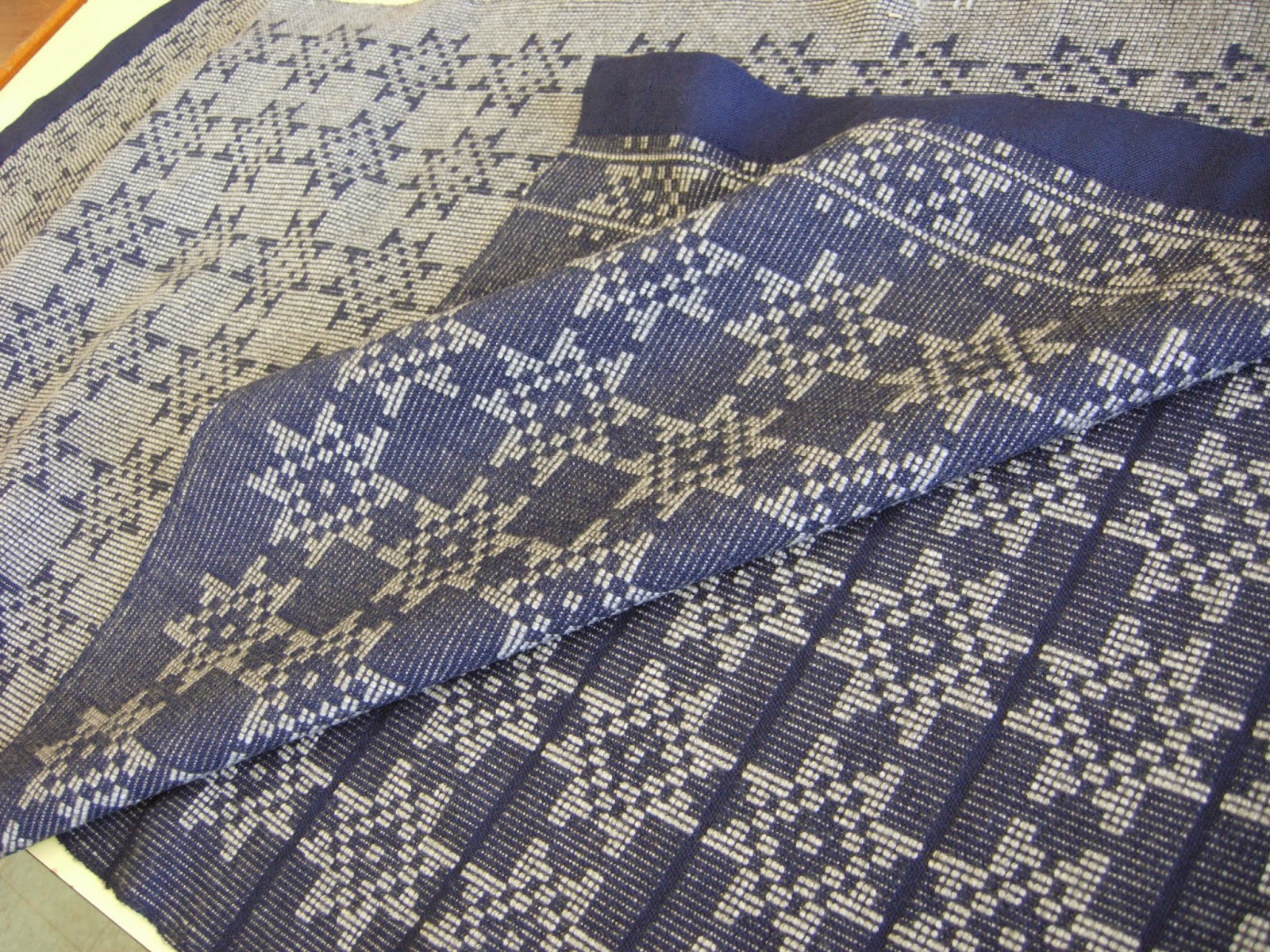
Runners by Judite Vagner
taken from Harriet Tidball's Canadian Weavers Guild Christmas Bulletin sample. The sample was meant to be a snowflake for a Christmas card and Judite repeated the motif to create the runners. And that brings me to .....
KNITTERS LOOM CORNER
Lesson 7 -   learn about unfamiliar weaving equipment and techniques. The nice thing about the knitters loom is that it allows for spontaneity and doesn't require as much planning. That too is important in our weaving practice. It enhances creativity and increases joy! 
Arlene Williams first project on her newly acquired knitters loom. She created the scarf to go with a hat she made for her mother. 


Karen Bota, sock yarn scarf

Carole Hibbert just bought a 28" knitters loom from me. She also bought a stand to attach it to. Perfect if you don't have any table space at home. It was super easy to assemble and disassemble. 

Lesson 8 - be helpful and supportive of others in their weaving forays, learning and experimentation. 
FATE, DESTINY AND SELF DETERMINATION : an international tapestry project
left to right: Bambi Rutledge, Tina Patsourakos and Christine Shipley . Below, Jutta Polomski help out with the finishing for the international tapestry project, Fate, Destiny and Self Determination.  You don't have to be a tapestry weaver to help and be included as one of the makers of the project!


 lesson 9 - take weaving workshops from as many different people you can. Each person has a wealth of experience, practice and knowledge and even if you know a lot, there is always something to be gained from another weaver. Plus, it's a great way to make new friends!

June Weaving Workshops

WOVEN SHIBORI June 2-6 2014 (5 days) $350 Burr House, Richmond Hill, On
Instructor: Kathleen Morris http://www.kathleen-morris.com/

Kathleen Morris is a Toronto-based designer/maker and educator working in the field of textiles. Her work has been exhibited at Prime Gallery, the OCC Gallery, David Kaye Gallery, the Guild Shop, and Craftworks. Her retail line of woven, resist-dye fabrics have been the mainstay of her textile production as have both publicly and privately commissioned works. Her public commissions include projects for Toronto's Metro Hall and Ontario's Expo pavillion. Her private commissions include innumerable film and theatrical assignments. Kathleen is an instructor in the Fibre program at OCAD University, recently completing her Masters, as well as an artist-educator in the Toronto District School Board. Materials must be purchased from the instructor. A 4 shaft or 8 shaft loom is required. Warps will be prepared in the workshop. Contact: Line Dufour tapestryline@sympatico.ca
Deadline to reserve: April 30, 2014

CRIMP AND CREATE June 10-12 2014 (3 days) $350 Burr House, Richmond Hill On
Instructor: Diane Totten  http://diannetottenhandwovens.com/
 This is an on-loom workshop taking fiber in a new direction by creating “crimp cloth.” Using a variation of woven shibori for both warp and weft, learn to create fabric with permanently crimped designs that hold their memory even when washed.  Participants will draft, weave, and crimp their samples in class to discover the endless possibilities. Learn how the fabric can be used for entire garments as well as for permanent pleating to replace knitted ribbing for a sweater or to add a knit look to the collar area of a jacket. Sewing tips for using this amazing cloth will be included.  No dyeing involved.   Skill level: Advanced beginner and beyond. Equipment required:
4 to 8 shaft loom 
Contact: Line Dufour tapestryline@sympatico.ca
Deadline to reserve: April 30, 2014


FONDAZIONE ARTE DELA SETA LISIO, Florence Italy June 23-27 2014
Instructor: Eva Basile - Intro to Jacquard Textiles
Explanations and examples of what damask, double cord damasks, brocaded damasks,  lampas, double cloth, (figured) velvets, brocades, brocatelle, taffeta, satin, samite, diaper and other luxury fabrics, analysis of fabrics, learning the European notation system for drafts, introduction to using manual jacquard looms and sampling existing patterns, Studying the textiles depicted in paintings of the Renaissance found at the Uffizi and other museums and galleries in Florence such as the  Costume museum, and the Museum of Textiles in Prato. 

Lisio has designed and executed fabrics for the Vatican, movies such as the Agony and the Ecstasy with Charles Heston and Rex Harrison, The Taming of the Shrew with Elizabeth Taylor and Richard Burton and has created designs for Fendi among many other designers such as Versace. They continue to collaborate with universities, musuems and art galleries all over the world in doing research and consultation. The course is $1500.  Students must arrange for and pay for their own transportation. Accommodation is included in the price.  Meals are an additional cost. To register or reserve your spot contact Line Dufour at tapestryline@sympatico.ca. A limit of 6 people will be admitted and the first six people to send a $250 deposit (non refundable) will ensure their participation in this very special opportunity. Some knowledge of weaving is required. Deadline to reserve: May 1 2014

Lesson 10 - go to weaving conferences when you can! They happen all over the world. 

Friday, February 14, 2014

Art Weaving Feast for Winter Weary Eyes


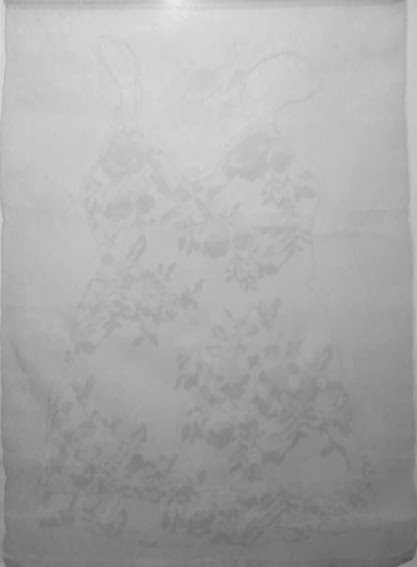
Yesterday I broke from my usual blogging and office work routine to head into the city (Toronto) - 75 km from where I live - to meet up with a friend, have lunch and then some exhibitions that included woven items. Before I share that with you, a reminder that it is not too late to see Nieves Carresco's exhibition at the David Kaye Gallery (http://www.davidkayegallery.com/). Nieves, architect by training with a textile background, has created beautifully and intricately woven fine strips of washi paper that she has painted on with ink (image shown above).
Imperial Floods, assorted synthetic and natural fibres. Tim Manalo. 

Our first stop was the Gladstone Hotel on Queen St West (http://www.gladstonehotel.com/, where we viewed the exhibition Hardtwist. You'll have to go to the third and fourth floors to see this interesting and thought provoking exhibition.Since there is so much available in terms of promoting other textile arts and crafts, I focused only on presenting what incorporated weaving.
Safe Keeping (Five Journals 1993-2013. Amy Bagshaw.
Some people of a certain generation and training may not find many of these pieces aesthetically pleasing, perhaps its because it is not their raison d'etre.  Instead the works presented  gave one much food for thought and provoked discussion, sometimes heated. 
Talking to Myself. woven woodcut print on paper. Ann Devitt. www.anndevitt.ca

Drawing/Weaving. Colleen McCarten. www.colleenmccarten.com. 
The piece on the left is woven in tabby, the roll of parchment on the right, is a very detailed drawing of weaving structure. I wondered to myself, is it asking that weaving be considered with the same respect and reverence as art or even architectural drafting. 
Marie Pierre Daigle. Mycelium. www.mpdaigle.com
"Mycelium is the vegetative part of a fungus, consisting of a mass of branching, thread-like hyphae. The mass of hyphae is sometimes called shiro, especially within the fairy ring fungi. Fungal colonies composed of mycelium are found in and on soil and many other substrates. A typical single spore germinates into a homokaryotic mycelium, which cannot reproduce sexually; when two compatible homokaryotic mycelia join and form a dikaryotic mycelium, that mycelium may form fruiting bodies such as mushrooms. A mycelium may be minute, forming a colony that is too small to see, or it may be extensive:
Is this the largest organism in the world? This 2,400-acre (9.7 km2) site in eastern Oregon had a contiguous growth of mycelium before logging roads cut through it.Estimated at 1,665 football fields in size and 2,200 years old, this one fungus has killed the forest above it several times over, and in so doing has built deeper soil layers that allow the growth of ever-larger stands of trees. Mushroom-forming forest fungi are unique in that their mycelial mats can achieve such massive proportions.
—Paul Stamets, Mycelium Running[1]
It is through the mycelium that a fungus absorbs nutrients from its environment. It does this in a two-stage process. First, the hyphae secrete enzymes onto or into the food source, which break down biological polymers into smaller units such as monomers. These monomers are then absorbed into the mycelium by facilitated diffusion and active transport.
Mycelium is vital in terrestrial and aquatic ecosystems for their role in the decomposition of plant material. They contribute to the organic fraction of soil, and their growth releases carbon dioxide back into the atmosphere. The mycelium of mycorrhizal fungi increases the efficiency of water and nutrient absorption of most plants and confers resistance to some plant pathogens. Mycelium is an important food source for many soil invertebrates.
One of the primary roles of fungi in an ecosystem is to decompose organic compounds. Petroleum products and pesticides, typical soil contaminants, are organic molecules, i.e. they are built on a carbon structure. This means that these substances present a potential carbon source for fungi. Hence, fungi have the potential to remove such pollutants from the soil environment, unless the chemicals prove toxic to the fungus. This biological degradation is a process known as bioremediation." Wikipedia
Joanna Schleimer. Slip. Hand woven silk. 
This piece was very finely woven, like a transparency technique. Joanna placed the weaving about an inch or 2 away from the base from the frame, so that when the light shone on it, it created a secondary shadow effect in the background. An enchanting and highly skilled piece of weaving and art. Here is a link to her website where you will see more mesmerizing work. http://joannaschleimer.com/

detail of Slip by Joanna Schleimer

Houpil 0102, by Hot Pop and Ozana Gherman. Two pieces were displayed side by side, both referencing back strap weaving though they were not technically woven on a backstrap loom. In the image below, you can read the specifics of this project.

Our last stop was at the Ontario Craft Council gallery at 990 Queen Street West to see the hand & MACHINE exhibition. Here too they had some interesting objects that referenced weaving technically and incorporated contemporary technological weaving approaches. Hot Pop does digital 3d printing http://www.hotpopfactory.com/index.html. Here's a little more info about Ozana - http://www.slideshare.net/ozanagherman. In the image below, you can read in more detail about what this piece is about.
The Ontario Craft Council has a new website to reflect it's new image and mandate http://craftontario.com. You may want to join when you see how they will assist you in marketing your work.

Weaving exhibitions, resources, information
Ted Hallman, once a teacher at OCADU, (and one of my instructors) is having an exhibition in Pennsylvania. Click on this link http://mhep.org/exhibits/ then click on the Hallman Legacy. 

Jenny Gilbert sends along this interesting link featuring weaving as art - both fabric and tapestry woven simple techniques. http://www.new-friends.us/

Inga Tomas sends this link along featuring her work: http://ingi.smugmug.com/WEAVING/n-JVbsp/i-QgWMkKd. She also highly recommends this book: 
Marilyn Hotta has a 60" loom for sale. Go to this link to find out more: http://toronto.kijiji.ca/c-buy-and-sell-hobbies-crafts-Leclerc-60-Colonial-Loom-W0QQAdIdZ548194621


Thursday, January 30, 2014

Exciting Weaving Directions


DAVID KAYE GALLERY : Woven Drawings by Nieves Carrasco
January 30 - February 23, 2014
Opening: Saturday, February 1, 2:00 - 4:00 p.m.1092 Queen Street West (entrance on Dovercourt)
Nieves says: As an artist, I have experimented with a diversity of techniques: drawing, painting, printing, dyeing, weaving, collage. Every few years though, I am compelled to return to weaving. This ancient technique continues to captivate me. By intersecting warp and weft, a pliable plane emerges, row by row, right in front of me where nothing existed before. It is magic.While the warp has structural constraints, almost any material can be used for the weft, including paper. Having used washi (handmade Japanese paper) in my work over the last few years, I was tempted to bring the universe of drawing into weaving through this material, which has unique textile qualities. My journey starts at the drawing board as I apply line, wash, and print in ink to washi and ends as the final composition is assembled, row by row at the loom. As fine strips of washi are woven, they are held in place by the warp threads. The cloth that emerges is both a textile and a drawing, with the loom repositioning the ink markings into new and unexpected imagery
Ashford Knitters Loom scarf by Jane Richmond
Talk to me about the Knitters loom and how easy it is to set up and finish a project in an evening. They come in three sizes: 12", 20" and 28". Here is link to some very inspiring ideas for knitters loom scarves: http://nls.interweave.com/t/bffbbLGQeQA2FeJ33lCUxaBHkaaaCUxBHk?p=6%40w70B&Z=yVuZxowtqdsZ_xtrkfonXt.Xf&Zj=ofkjnym3gnij_n3huVydhj.hV&q=88l&2=&m=%23

We are still trying to sell student work at the Toronto Weaving School however, stock is dismally low. People are wanting to buy for birthdays, anniversaries, weddings, and Mother's Day is also coming up. We welcome hand woven hand towels, dishtowels (or tea towels), as well as scarves and shawls. 

Knitters Loom scarves by Phyllis Fitzsimmons. 
Phyllis is making scarves with her knitters loom to give to homeless people. If you have scarves, mitts and hats to donate for homeless people (either hand made or commercial) please bring them to the weaving class and we will give them to Julia Pelenyi who volunteers with In from the Cold. 

Rep Weave rug by Wendy Szpindel
Many of us had to put our heads together to understand the draft for this pattern. Wendy whipped this up over the holiday season.Congratulations Wendy. The pattern was taken from Laila Lundell's Rep Weaves Book. 
Rep Weave rug by Christine Shipley. 
Christine took her pattern from the book Custom Woven Interiors by Kelly Marshall.

WEAVING WORKSHOPS JUNE 2014


WOVEN SHIBORI June 2-6 2014 (5 days) $350 Burr House, Richmond Hill, On

Instructor: Kathleen Morris http://www.kathleen-morris.com/

Kathleen Morris is a Toronto-based designer/maker and educator working in the field of textiles. Her work has been exhibited at Prime Gallery, the OCC Gallery, David Kaye Gallery, the Guild Shop, and Craftworks. Her retail line of woven, resist-dye fabrics have been the mainstay of her textile production as have both publicly and privately commissioned works. Her public commissions include projects for Toronto's Metro Hall and Ontario's Expo pavillion. Her private commissions include innumerable film and theatrical assignments. Kathleen is an instructor in the Fibre program at OCAD University, recently completing her Masters, as well as an artist-educator in the Toronto District School Board. Materials must be purchased from the instructor. A 4 shaft or 8 shaft loom is required. Warps will be prepared in the workshop. Contact: Line Dufour tapestryline@sympatico.ca Deadline to reserve: April 30, 2014


CRIMP AND CREATE June 10-12 2014 (3 days) $350 Burr House, Richmond Hill On
Instructor: Diane Totten http://diannetottenhandwovens.com/
This is an on-loom workshop taking fiber in a new direction by creating “crimp cloth.” Using a variation of woven shibori for both warp and weft, learn to create fabric with permanently crimped designs that hold their memory even when washed.  Participants will draft, weave, and crimp their samples in class to discover the endless possibilities. Learn how the fabric can be used for entire garments as well as for permanent pleating to replace knitted ribbing for a sweater or to add a knit look to the collar area of a jacket. Sewing tips for using this amazing cloth will be included.  No dyeing involved.   Skill level: Advanced beginner and beyond. Equipment required:
4 to 8 shaft loom 
Contact: Line Dufour tapestryline@sympatico.ca
Deadline to reserve: April 30, 2014

Want to know how these sumptuous velvets were created? Take this course in Florence at the Fondazione Arte della Seta Lisio. http://www.fondazionelisio.org/
FONDAZIONE ARTE DELA SETA LISIO, Florence Italy June 23-27 2014
Instructor: Eva Basile - Intro to Jacquard Textiles 

Explanations and examples of what damask, double cord damasks, brocaded damasks,  lampas, double cloth, (figured) velvets, brocades, brocatelle, taffeta, satin, samite, diaper and other luxury fabrics, analysis of fabrics, learning the European notation system for drafts, introduction to using manual jacquard looms and sampling existing patterns, Studying the textiles depicted in paintings of the Renaissance found at the Uffizi and other museums and galleries in Florence such as the  Costume museum, and the Museum of Textiles in Prato. 

Lisio has designed and executed fabrics for the Vatican, movies such as the Agony and the Ecstasy with Charles Heston and Rex Harrison, The Taming of the Shrew with Elizabeth Taylor and Richard Burton and has created designs for Fendi among many other designers such as Versace. They continue to collaborate with universities, musuems and art galleries all over the world in doing research and consultation. The course is $1500.  Students must arrange for and pay for their own transportation. Accommodation is included in the price.  Meals are an additional cost. To register or reserve your spot contact Line Dufour at tapestryline@sympatico.ca. A limit of 6 people will be admitted and the first six people to send a $250 deposit (non refundable) will ensure their participation in this very special opportunity. Some knowledge of weaving is required. Deadline to reserve: May 1 2014


Thursday, January 23, 2014

The Influence of Japanese Textiles on Ontario Weavers and Spinners

Nieves Carrasco preparing for her upcoming exhibition.
There are a number of events and exhibitions happening over the next month or two that are all connected to the influence of Japanese weaving and spinning practice on Ontario Weavers and Spinners  their inspiration is palpable and evident in  the Toronto weaving/spinning (textile/fibre) community. This influence has been growing steadily over the last several decades, and Japanese practices are making their way into our own contemporary practice as many artists absorb their traditions and put their own 'spin' on it. 

shibori/weaving

Corteza - Click for a more detailed view


CORTEZA: Nieves Carrasco
resist-dyed wool tapestry weaving
50 x 65cm
“Telar y shibori: el arte de tejer y teñir”
Instituto Chileno Norteamericano de Cultura. April 2003, Santiago, Chile
(exhibition sponsored by the Canadian Embassy in Chile)
(shown also at Common Thread 2005, Oakville, Ontario, Canada
Nieves Carrasco been greatly influenced by  Japanese textile traditions and has demonstrated that in her woven work in various formats. Recently she started  weaving with paper, hand cutting hundreds of thin strips to create architecturally flavoured wall hangings. Her work has a zen quality, almost minimalist, which is also often associated with the Japanese practices. She has an exhibition coming up at the David Kaye Gallery. The opening will be February 1 between 2-4pm. For more info go to http://davidkayegallery.com/?page_id=977 

Born and raised in Santiago, Chile, and now living in Toronto, Nieves studied fine arts and textile design at the Universidad Catolica in Santiago. She continued her studies in architecture at the Universtiy of Calgary, Alberta graduating with a Master's degree in environmental design. She has exhibited  work extensively. You can learn more about Nieves on her website: http://www.nievescarrasco.com/home.html. 
Work of Judith Fielder
Some of my (ex) students know about Judith Fielder's work who has also been greatly influenced by Japanese traditions, shown above at the exhibition "Found in Translation" at the Japanese Cultural Centre. Judith exhibited with Nieves Carrasco, as well as a couple of other artists.

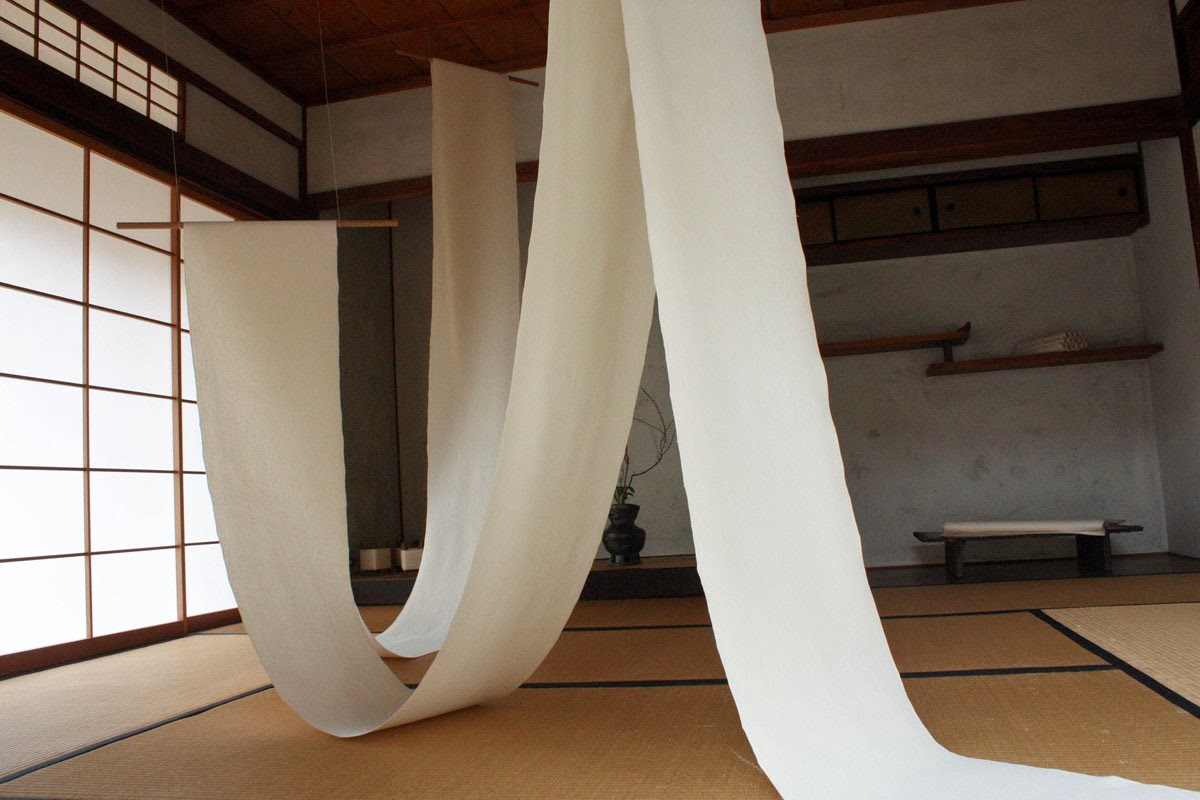
Earlier this January we were introduced to Hiroko Karuno, who spoke at the Toronto Weavers and Spinners at Riverdale Farm. There she gave us demonstrations of the process of spinning paper, and showed us some examples of textiles woven with paper. If you couldn't make it out then, maybe you can make it to her next engagement: 
Book Launch February 19 at the Japanese Paper Place: http://www.japanesepaperplace.com/goings-on/workshops.htm
Hiroko Karuno. A length of spun and woven paper on exhibition in Japan. 
You can see more of her work at : http://hirokokaruno.in.coocan.jp/


and many of us remember the wonderful kasuri workshop given by Keiko Shintani in the summer of 2012. Keiko has been teaching her japanese kasuri techniques for many decades now here in Ontario. 

And finally, in the same theme, the Textile Museum of Canada has an upcoming exhibition entitled From Geisha to Diva: the Kimonos of Ichimaru. 
"The fascinating life of Ichimaru (1906-1997), one of the most famous geishas of the 20th century due to her exceptional singing voice, is told through this collection of her magnificent kimonos and other personal effects."
This promises to be very exciting indeed! Click on this link to learn more about it: http://www.textilemuseum.ca/apps/index.cfm?page=exhibition.detail&exhId=356

OTHER RESOURCES, EXHIBITIONS (some Japanese related, some not)
World Ethical Apparel Roundtable, Brickworks,  Toronto

Korean paper spinning and basket weaving 
Weaving Cloth from Tosa-washi(Japanese Paper from Kochi in Shikoku, Japan) 

Saganishiki - Japanese silk & paper brocade

Grethe Whittrock paper artist 


World Shibori Network
http://shibori.org/

hand and MACHINE OCC gallery, 990 Queen Street West
http://www.craft.on.ca/Exhibitions/Upcoming_Exhibitions?utm_source=Active+Members+December+17%2c+2013&utm_campaign=1b59500f70-Craftfl_sh_February_20132_15_2013&utm_medium=email&utm_term=0_febc5ca6b6-1b59500f70-117239829

Hard Twist, Gladstone Hotel Toronto : January 23 - April 27. an annual juried show of work that celebrates the intimate, layered and complex relationship between people and textile, has become an important annual event within the Canadian fibre art community and a signature event for the Gladstone since 2006.
Participants range from established artists with impressive track records to students in the process of refining their focus. The works are tiny and huge, straightforward and complex, representational and abstract, and speak of things as disparate as biblical lyrics, global warming and the fate of dryer lint.
Each year, co-curators Helena Frei and Chris Mitchell weave this wild diversity into a rich and complex tapestry inhabited by a powerful sense of human creativity. 
http://www.gladstonehotel.com/spaces/hard-twist/

Wearable Technology Open Studio: 
Erin Lewis will be hosting a monthly Wearables Open Studio at Interaccess Media Arts Centre. The studio will be open on the last Wednesday of each month, from 7-10pm.  You are all invited to drop by to chat about ideas, to work on projects, get support in your work, and of course just to hang out in person and say hello!  It's also FREE.  The next Wearables Open Studio will happen on Wednesday January 29th, from 7-10pm.  Please spread the word.
Wearables Open Studio Night
Wednesday January 29th, 7-10pm
9 Ossington Avenue (at Queen St. W).

Thursday, January 16, 2014

Spring and Summer Weaving Workshops

Toronto Weaving School has organized some exciting Master Classes in Weaving for the intermediate to advanced weaver. In addition, there are other workshops happening around the GTA and southern Ontario in the spring and you may be interested in those. 
WOVEN SHIBORI June 2-6 2014 (5 days) $350 Burr House, Richmond Hill, On
Instructor: Kathleen Morris http://www.kathleen-morris.com/

Kathleen Morris is a Toronto-based designer/maker and educator working in the field of textiles. Her work has been exhibited at Prime Gallery, the OCC Gallery, David Kaye Gallery, the Guild Shop, and Craftworks. Her retail line of woven, resist-dye fabrics have been the mainstay of her textile production as have both publicly and privately commissioned works. Her public commissions include projects for Toronto's Metro Hall and Ontario's Expo pavillion. Her private commissions include innumerable film and theatrical assignments. Kathleen is an instructor in the Fibre program at OCAD University, recently completing her Masters, as well as an artist-educator in the Toronto District School Board. Materials must be purchased from the instructor. A 4 shaft or 8 shaft loom is required. Warps will be prepared in the workshop. Contact: Line Dufour tapestryline@sympatico.ca

CRIMP AND CREATE June 10-12 2014 (3 days) $350 Burr House, Richmond Hill On
Instructor: Diane Totten http://diannetottenhandwovens.com/


 This is an on-loom workshop taking fiber in a new direction by creating “crimp cloth.”  Using a variation of woven shibori for both warp and weft, learn to create fabric with permanently crimped designs that hold their memory even when washed.  Participants will draft, weave, and crimp their samples in class to discover the endless possibilities.  Learn how the fabric can be used for entire garments as well as for permanent pleating to replace knitted ribbing for a sweater or to add a knit look to the collar area of a jacket.  Sewing tips for using this amazing cloth will be included.  No dyeing involved.   Skill level: Advanced beginner and beyond. Equipment required:
4 to 8 shaft loom 
Contact: Line Dufour tapestryline@sympatico.ca


FONDAZIONE ARTE DELA SETA LISIO, Florence Italy June 16-20 2014
Instructor: Eva Basile - Intro to Jacquard Textiles June 16-20 2014
Explanations and examples of what damask, double cord damasks, brocaded damasks,  lampas, double cloth, (figured) velvets, brocades, brocatelle, taffeta, satin, samite, diaper and other luxury fabrics, analysis of fabrics, learning the European notation system for drafts, introduction to using manual jacquard looms and sampling existing patterns, Studying the textiles depicted in paintings of the Renaissance found at the Uffizi and other museums and galleries in Florence such as the  Costume museum, and the Museum of Textiles in Prato. 

Lisio has designed and executed fabrics for the Vatican, movies such as the Agony and the Ecstasy with Charles Heston and Rex Harrison, The Taming of the Shrew with Elizabeth Taylor and Richard Burton and has created designs for Fendi among many other designers such as Versace. They continue to collaborate with universities, musuems and art galleries all over the world in doing research and consultation. Students must arrange for and pay for their own transportation. Accommodation is included in the price but the final price is still in negotiation. To register or reserve your spot contact Line Dufour at tapestryline@sympatico.ca. A limit of 6 people will be admitted and the first six people to send a $250 deposit (non refundable) will ensure their participation in this very special opportunity. Some knowledge of weaving is required. 
Linen Workshop, $280, materials $45 Riverdale Farm, Toronto, Saturday March 29 - Monday March 31 2014 9am to 4pm. Registration deadline: Friday February 28. 
Instructor: Jette Vandermeiden
Description:  This workshop runs for three consecutive days, where we will learn how to work with linen, make a proper warp, dress the loom appropriate to linen and also do some weaving on day three. Samples will include standard linen weaves such as block twill, huck lace, dimity, Bronson, and 6-end twill. The emphasis will be on the process, rather than weaving a project, with the objectives of handling linen well, proper warping, pre-sleying in a coarse reed, using a trapeze for great beaming, transferring the cross easily, winding a successful bobbin, and good linen weaving techniques. Topics for discussion will include different kinds and sizes of linen, recommended linen weave structures, tricks for good edges and finishing. Weavers will go home with a few samples, but more a thorough knowledge of the process of weaving linen. 
Contact: Marion Kirkwood markirk@rogers.com

2 day Polychrome Crackle Workshop April 12/13, 2014 Saturday and Sunday 9 am-4 pm
Instructor: Jette Vandermeiden
CAW Hall 611 Silvercreek Pkwy N, Guelph, ON N1H 1E6, 1-519-822-6121
Required: 4 shaft OR 8 shaft portable loom, pencils and paper and your own lunch.
The workshop area and washrooms are all on the main floor. There is also a small kitchenette for coffee and tea. – warping instructions will be provided closer to the workshop.
Cost: $85 for Guelph guild members (Please make cheques payable to: Guelph Guild of Handweavers and Spinners) $100 for members from outside guilds (registration from outside of the guild will begin in January 2014) materials additional. 
Contact: Elizabeth Bryan at weaverbee@start.ca

OTHER RESOURCES, INSPIRATION AND INFORMATION
Laura de Vrij sent this very inspiring project undertaken by  weavers in Indiana, weaving inspired by the Northern Lights http://www.weavingindiana.org/PDFs/MidnightStreamers.pdf

Mary Pietropaoulo received a very interesting Christmas present. A murder mystery based on weaving! Sorry ....couldn't get it to rotate. Sometimes the computer is not very cooperative!
An opening reception at the Ontario Craft Council gallery at 990 Queen Street West January 23 2014. The exhibit is presently on display. More info can be obtained at this link.
http://www.craft.on.ca/Exhibitions/Upcoming_Exhibitions?utm_source=Active+Members+December+17%2c+2013&utm_campaign=1b59500f70-Craftfl_sh_February_20132_15_2013&utm_medium=email&utm_term=0_febc5ca6b6-1b59500f70-117239829


One of my favorite Jacquard weavers is having an opening this Saturday. Maybe I'll see you there? Cheers!


Wednesday, January 8, 2014

Contemporary Weaving books are inspiring

This past summer I took a jacquard weaving course in Florence, Italy and one of my instructors was Julie Holyoke, who just recently released this book. Julie is an international textile consultant, presenter, speaker and instructor in digital textile design. She has been living in Florence since her adolescence, but is originally from the USA. She is fluent in both English and Italian. Below is a link to Amazon where you can buy her book. 

Inge Dam lives here in Shomberg, Ontario and has established quite a reputation for herself as a weaver. She's given many workshops for the Handweavers Guild of America at their Convergence conferences and recently she just released a book entitled Tablet-Woven Accents for Designer Fabrics: Contemporary Uses for Anceint Techniques.  It was recently reviews in Handwoven magazine in their last issue and here is a link to the spot on her website that features the book and offers you the option to buy it. http://www.ingedam.net/book.html#.Us1cP_RDuSo. The following link is her website.  http://www.ingedam.net/

Hiroko Karuno, an expert in "shifu" spinning and weaving, and has just come out with a beautiful bilingual book: Kigami and Kami-ito: Japanese handmade paper and paper thread.  It describes not only the history of  shifu weaving, but shows amazingly detailed technical information on how to create the paper yarn on your own. You can order it at Habu yarns for $45 plus shipping but if you attend the talk at the Toronto Weavers and Spinners this evening (Wednesday January 8 2014 at 7a;30 pm, she will be selling copies for only $30 as well as giving a slide presentation of her apprenticeship in the technique of creating the paper, spinning the paper and weaving with it. It is the way of the future for fibre as it is entirely recyclable and does not cause any damage to the planet. Selvedge magazine featured an article on her work: http://www.exacteditions.com/read/selvedge/issue-22-3586/26/2/


RESOURCES
Recently I discovered Pinterest though I've known its been around for the last few years. I was looking for handweaving patterns and discovered that they have thousands, for every level of weaver. While I was searching on Pinterest, I also discovered this great site for looking for patterns: http://handweaving.net/DraftsHome.aspx.

EXHIBITIONS


January 9 - March 15, 2014

Opening Reception Thursday, January 23, 6 – 9 pm


Ontario Crafts Council Gallery
990 Queen Street West, Toronto
http://www.craft.on.ca/Exhibitions/Upcoming_Exhibitions?utm_source=Active+Members+December+17%2c+2013&utm_campaign=1b59500f70-Craftfl_sh_February_20132_15_2013&utm_medium=email&utm_term=0_febc5ca6b6-1b59500f70-117239829

Wednesday, December 4, 2013

Wrapping up the Session


Donna Kim has a chair caning business in Toronto (link on the right of thi spage - Edge of your Seat) and these days she's also exploring basket weaving. Here she isshowing us the results of her shibori classes with the Toronto Weaving School offered last spring. This was done by folding, clamping a piece of wood onto the fabric, then dyeing. 

Recently I had a great talk with a new student in my class. Her name is Sharon Alexander and she has her own photogrpahy and graphic design business. http://alexanderstudio.dphoto.com/. One of the comments she made while we were talking is that it was surprise to her that the weaving classes were so much more than just learning to weave classes - that connections and bonding happened, new friends made.....a supportive and caring environment for each participant. (Now that I know that she's a photographer though, hope she won't find the pictures of my classes and projects too appalling!) Continuing with the theme we have been exploring over the last several blogs about how weaving is such a good metaphor for life, once again it is apropos in describing these social interlacements. 
Though the designs seem simple, Donna spent hours sewing and wrapping which created resist areas where the dye could not penetrate. 

Weaving is usually considered a solitary practice. In part this is what might draw people to weaving. I've read some enlightening books about solitude as well as on creativity and solitude is very much linked to the process of creativity. In solitude, we have time to connect to our own thoughts and feelings, our own ideas and give our attention to learning something new. Through solitude, we reflect on other things going on in our lives and to find meaning in it all. From the chaos created from the sometimes tangled threads of thoughts, emotions, relationships and life situations, we can find some order (peace) in these moments of solitude. 

More results from Donna's foray into shibori techniques - above and below. 
 One of my favorite books on solitude is by Anthony Storr entitled Solitude: A return to the Self : http://books.google.ca/books/about/Solitude.html?id=graaRCq83QMC&redir_esc=y

Undoubtedly, much as I appreciate my times of solitude, I equally appreciate time with others. It's energizing, stimulating and keeps me motivated and enjoying life.

Melissa Nurmi knitters loom scarf made with assorted yarns. 

Sandi Dunn created two beautifully woven Rep weave rugs. The designs were taken from Laila Lundell's book: Repweave: 27 projects page 28. 

"When from our better selves we have too long
Been parted by the hurrying world, and droop,
Sick of its business, of its pleasures tired,
How gracious, how benign, is Solitude."

— The Prelude by Wordsworth
Resources, links etc.....
Branch Ranch
Here's a place to go in Ontario that sells all kinds of branches for basket weaving and decoration: http://www.thestar.com/life/2013/11/22/at_the_branch_ranch_an_unusual_farm_they_grow_what_else_branches.html

Check out and subscribe to Joe Lewis fibreQuarterly, an online fibre magazine. Joe himself has an immense knowledge of weaving and often features it in his magazine. https://www.facebook.com/groups/fibreQuarterlyGroupies/permalink/10151920049629597/. Recently he posted that Canadian Amanda McCavour, who was not only one of two recipients of the HGA"s Dendel Scholarship given by the Handweaver's Guild of America aka HGA, but is the current cover story of their magazine, Shuttle, Spindle and Dyepot. http://www.weavespindye.org/pages/?loc=1-60-00&p=cover.html. Thanks Joe!