Thursday, April 17, 2014

Red


Repp weave rug by Lis Baston
4/8 cotton and cotton rug filler
Over the centuries the colour red has been obtained by using lead, bugs, and plants. It is one of the first colours to be produced by humans and at first was used to paint their bodies and then on cave walls and rocks. The fact that it is also the colour of the life giving fluid , blood, makes it even more of a  powerful colour charged with symbolism and significance.

Knitters loom hand towel in 4/8 cotton by Carole Hibbert
When the Spanish conquistador Hernán Cortés and his soldiers conquered the Aztec Empire in 1521, besides discovering silver and gold, they uncovered that the Aztecs obtained a spectacular red from drying and crushing a tiny cochineal, a parasitic scale insect which lived on cactus plants. They exported these to Europe where they provided them to  textile dyers. 
Wendy Hayden giving us a talk about her one week workshop on Colour and Design for weaving at Jane Stafford in British Columbia. 
At first dyers guilds' in Venice and other cities banned cochineal to protect their local products, but the superior quality of cochineal dye made it impossible to resist. By the beginning of the 17th century it was the preferred luxury red for the clothing of cardinals, bankers, courtisans and aristocrats.

One of the samples that Wendy Hayden wove at Jane Stafford. The stripes designed by using the Fibonacci series. 
Another of the samples that Wendy Hayden wove at Jane Stafford. The stripes designed by using the Fibonacci series. See how the red accent livens the composition. Jane calls this the 'zinger'. 

Another sample that Wendy Hayden wove at Jane Stafford. 
There are many names given to red paints and pigments: vermilion, madder, scarlet, cerise, persimmon, sanguine, cinnabar, rouge, crimson, carmine, geranium, ruby and rose.Every textile can benefit by warming with red giving life to a muted colour palette. 

Houses tapestry by Christine Shipley. Measures approximately 4" x 10"

Red is charged with emotion and possibility.  Red conveys heroism and bravery, honesty and patriotism, strength, power, authority. It demands that you pay attention to it. It can represent many emotions: love, hate, anger, passion, lust. Love may be like a red red rose, as one's  sins. Even  politics may be red. One "sees red" when angry. There is red tape, red ink, red wine, red lips, red blood, red earth, red barons, red barns, red hearts, red thoughts and red herrings. Even women have been described as scarlet and we all know what a red light district is. 
Baby wrap woven by Heather Brady , commissioned by Emma Cummingham, who is a newcomer (and student) to weaving. Sett - 24 epi, Heather used  8/2 cotton warp, cottolin weft (black).  The final dimensions are 29" wide and 5.1 yards long after washing, drying and hemming (it was 19 ft fresh off the loom).  Wow! impressive length!

Red is the color most commonly associated with joy and well being,  celebration and ceremony. A red carpet is often used to welcome distinguished guests. Red is also the traditional color of seats in opera houses and theaters. Scarlet academic gowns are worn by new Doctors of Philosophy at degree ceremonies at Oxford University and other schools. In China, it is considered the color of good fortune and prosperity, and is traditionally worn by brides. In Christian countries, it is the color traditionally worn at Christmas by Santa Claus, because in the 4th century the historic Saint Nicholas was the Greek Christian Bishop of Myra, in modern-day Turkey, and bishops then dressed in red.

Emma Cummingham modelling the baby wrap that Heather Brady wove for her.


50 Ways to wear a scarf 
on YouTube sent to Marion Kirkwood by her daughter:
https://www.youtube.com/v/5LYAEz777AU?version=3&hl=en_US&rel=0

Here we welcome new weaving students in our Monday evening class: from left to right, Lisa Linkovich, Ryan Hayes, and Araceli Baleog. 

Fondazione arte della Seta Lisio June 8 - 12 2015
There are only 3 spots available to attend this one week workshop on historical jacquard textiles, which will include museum and art gallery visits and talks relating to jacquard textiles in renaissance paintings. To find out more contact Line Dufour at linedufour.tapestry@gmail.com. 

Thursday, April 10, 2014

Pink

The Toronto District School Board deemed April 9 as Stop Bullying day. People were invited to wear pink and this Louise Granahan did with style and flare. To learn more about the colour pink (and I didn't know it such a somewhat controversial history!) go to http://en.wikipedia.org/wiki/Pink. Louise has decided to learn 7 different kinds of weaving or try different weaving techniques and/or looms. Inkle loom weaving is her most recent foray. Perhaps we should talk about how you can weave a boa too! 
She has also tried tapestry weaving and the doubleweave sampler. 
Wendy Szpindel wove this 8 shaft blanket with 2 ply Lemieux yarn on her loom at home. It fulled beautifully and with little effort. She used a top loader and being unable to control it , the blanket was at the mercy of the machine. I thought that was very courageous of her considering how much effort was required to weave it. 
Judite Vangers wove  the 8 shaft blue scarf above (18/2 merino) at school ......

and tried it in another version of the pattern at home with a different yarn

KNITTERS LOOM CORNER. 

Arlene Williams - cotton scarf

Arlene Williams - cotton scarf

OTHER NEWS

The Louet Jane 8 shaft tableloom draw is on again! ( and no, the stand does not come with it) . $25 a ticket or 3 for $50. Proceeds go to the Toronto Weaving School.

I now have cottolin available in the weaving class. It's made with organic cotton and linen (60% cotton, 40% linen). This is especially good for weaving tea towels (dish cloths) .

Friday, March 28, 2014

Simon Says


Doubleweave throw inspired by a Madelyn Vanderhoght design . Woven by Julia Pelenyi.
Remember those games some of us of a certain age played as kids? One of them was Simon Says (or Simple Simon Says). One player takes the role of Simon who is the command giver. Players are only supposed to do as instructed when the command is preceded by "Simon says". All other instructions are to be ignored.  Players are eliminated from the game by either following instructions that are not immediately preceded by the phrase, or by failing to follow an instruction which does include the phrase "Simon says". 

Doubleweave throw inspired by a Madelyn Vanderhoght design . Woven by Julia Pelenyi. Jessica Brousseau wanted to give it a try!
There is little emphasis on physical capacity and what is developed  is the ability to distinguish between valid and invalid commands. The winner of the game is usually the last player who has successfully followed all of the given commands. Another version of this game was "Mother may I".
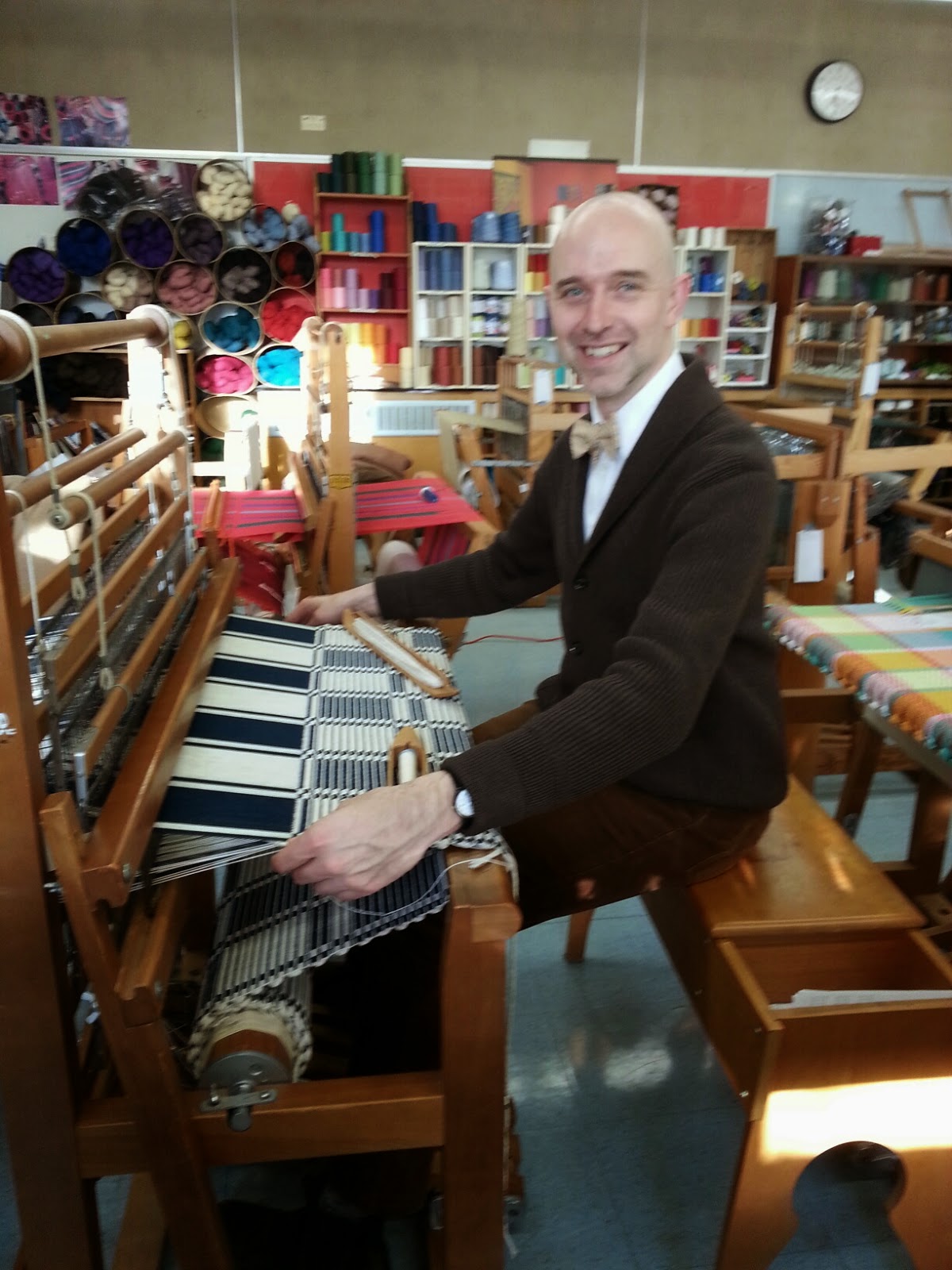
Conrad Dueck weaving his repp weave rug.

Conrad Dueck's repp weave rug taken from Laila Lundell's book. 
I guess you are wondering what got me thinking about these  games? Many of us are instruction challenged (and I can say that is true for myself as well - I don't follow instructions well which is why I try to be giving them rather than taking them!) .  Try an experiment. If  I gave you 10 different instructions, and then you had to do exactly what I said all in sequence, without my repeating, just how correctly would you execute those instructions? I know I wouldn't do very well given that set of circumstances. Just try remembering a set of driving instructions someone gives you for a place you are looking for....don't you usually have to ask at least one other person , that is to say pre-GPS! Even with the GPS I'm challenged to do exactly what it says! As to the above project, the repp weave rug by Conrad, this is perfect example of changing the instructions. Sometimes a set of instructions are more complicated than they have to be and so I adapted them so that they were easier to execute. Perhaps these various interpretations and variations on how to do something illustrates our capacity to process information in so many unique ways, arriving at the same result, but with different paths or maps so to speak. Which makes me wonder how in the world we manage to get along, get anything done and understand each other.  Assumptions, interpretations, distractions, life's troubles and challenges really impact on how we understand or don't understand what is said! As somone once said to me recently, these various interpretations gives the experience another texture and dimension, and affirms that  individuality and personality overrides conformity eventually. Yes! It must be so and I wouldn't want it any other way!

Below, pictures of a day (and evening) in the weaving class! 

Kim Dayman
Agota Dolinay 

Judite Vagners

Susan Abrams

Marion Kirkwood

Darlene Haywood

Gert Rogers

Bonnie Thorn

Jane Richmond

from left to right: Andrew White, Helen Skelton, Mary Pietropaoulo, Ann Marie , Andrea Kristoff

Left to right: Lis Bastion, Patti Wibe

Emma Cunnigham


Woven Shibori Workshop - June 2-6. If you are interested please contact me: linedufour.tapestry@gmail.com

Crimp and Create weaving workshop - June 10-12 If you are interested please contact me linedufour.tapestry@gmail.com

The Tapestry Blog http://tapestryline.blogspot.ca/2014/03/simon-says.html

Friday, March 21, 2014

The Colours of Spring

Rippling waves shawl in bamboo, by Karen Bota. Inspired by a Overshot Leaves on page 118 in the Handweavers Pattern Direcotry, pattern 2. 

Christine Shipley's daughter bought her a scarf (on left) from her travels. Christine used left over self striping sock yarn to recreate a similar design. She used an 18/2 merino for the weft and was woven in plain weave. 

Lavender Placemats with napkins by Toshiko Shindo in a bird's eye pattern. 


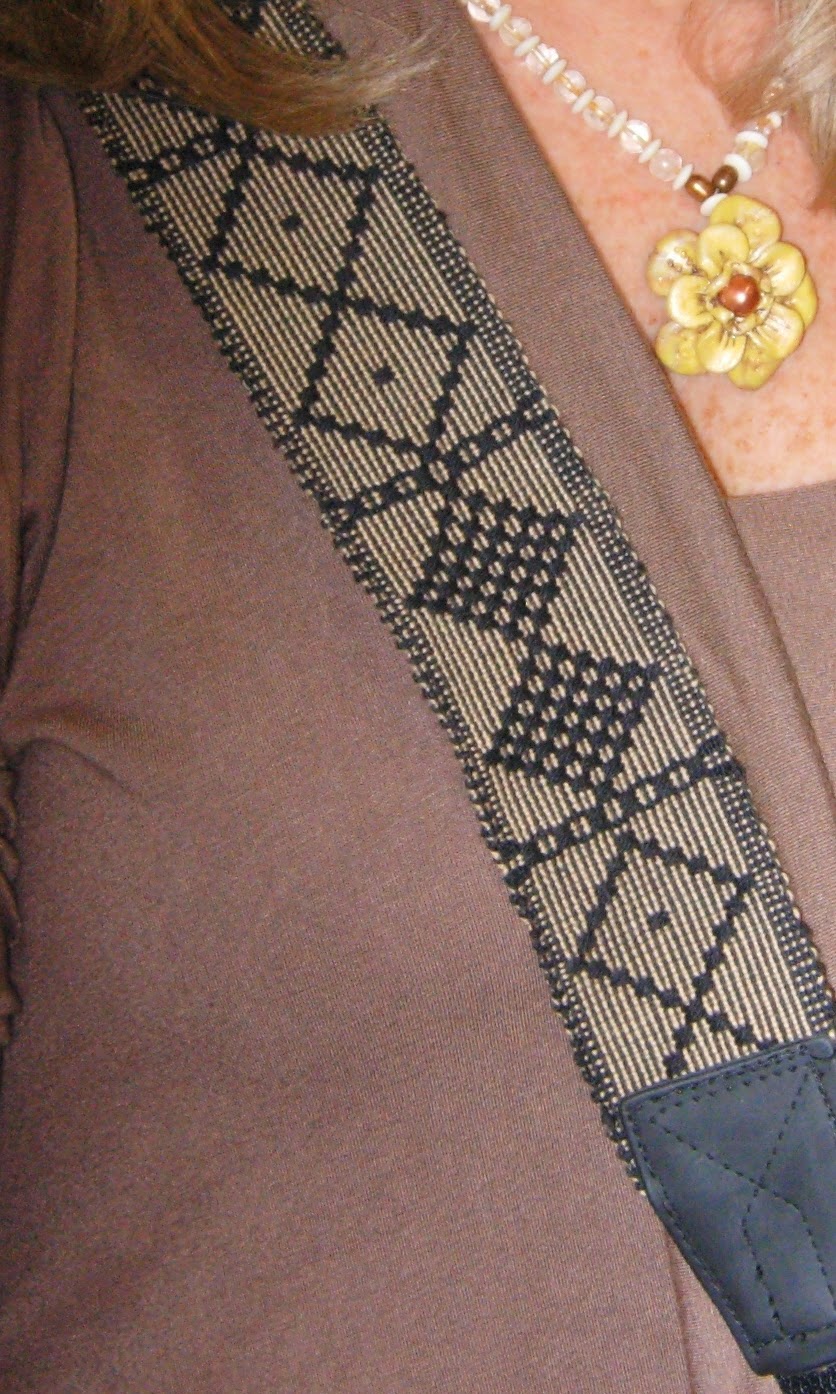
Lann Smith wove this camera strap based on an inkle loom design. 

a detail of the camera strap. She bought a cheap camera strap, dismantled it and used it to integrate her inkle woven strap. 

Louise Granahan was in the St Patrick's Day spirit by making green her theme. She wears a bamboo green and white scarf she wove, wears a green pendant she made, is wearing a green blouse and bracelet and is weaving a green scarf on a knitters loom. Louise loves the spontaneity of the knitters loom and its simplicity. 

Over March Break I visited the Textile Museum of Canada to see their From Geisha to Diva Exhibit. There wasn't too much in the way of handweaving but I fell in love with this piece that was an excellent sample of shibori. If you'd like to see the exhibit go to http://www.textilemuseum.ca/apps/index.cfm?page=exhibition.detail&exhId=356

KNITTERS LOOM CORNER
The latest projects to come off the knitters loom.

Arlene Williams wove this neutral black , gray and white scarf. She used an assortment of different knitting yarns and discovered that once washed they had different shrink rates giving her an unexpected result. 

Gert Rogers used a lopi yarn to create this scarf. 

Sandra Dunn has this lovely counterbalance 2 harness wood loom made by Lily Mills Manufacturing from Shelby, North Caroline. It once was a yarn manufacturing company. This is a lovely little loom....well made and designed. Sandra is interested in selling it though she has not determined a price. You can contact me at tapestryline@sympatico.ca  or come to the weaving classes to discuss with her. 

Weaving resources, links, courses and inspiration

Courses

OCADU Continuing Education Wearable Technology II  with Erin Lewis https://continuingstudies.ocad.ca/class_details.jsp?offeringId=625&show_past=false

Woven Shibori with Kathleen Morris,
http://www.kathleen-morris.com/
(Toronto Weaving School at Burr House)
June 2-6 2014
$350. for more info contact Line at tapestryline@sympatico.ca.


Crimp and Create with Dianne Totten
(Toronto Weaving School at Burr House)
June 10-12 2014
$350. for more info contact Line at tapestryline@sympatico.ca.


A while back we were wondering what a kite stick was as it related to weaving. Inge Thomas took it upon herself to illuminate us. She sent along this information https://bay178.mail.live.com/default.aspx?id=64855&rru=inbox#!/mail/ViewOfficePreview.aspx?messageid=cc288f50-959a-11e3-b2e4-00237de3d374&folderid=cca4b819-c3ad-43bb-85ac-bf300f2fabbb&attindex=0&cp=-1&attdepth=0&n=896381700

The Ontario Handweavers and Spinners have organized a weaving conference:
Wasoon [Weavers and Spinners Of Ontario North]
Invites you to Something Superior May 2-4,2014 in Sault Ste. Marie, ON
2 speakers- Kati Meek and Su Butler
Workshops,Suppliers, Displays, Silent Auction. Invitational Show of Plainly Superior works by attendees
See www.ohs.on.ca for registration and accommodation details or contact russ.mason@shaw.ca

Tapestry News
http://tapestryline.blogspot.ca/2014/03/50-pairs-of-hands.html

Thursday, February 27, 2014

February Blahs

Double weave log cabin Lemieux blanket woven by Darlene Haywood. It felt luxuriously soft after washed and brushed. A beautiful job that took several months to create. The pattern was taken from Handwoven January/February 2012, 

Do you feel the  stresses of your everyday life are getting to you these days? Do you feel that negativity and aggression are wearing you down? Its that time of year when we fall prey to the rigourous hardships of the winter, and this winter has been especially punishing. Our positive feelings seem to erode, our negative   ones may come to the surface, or we may be easily discouraged. Compounded with this are the hardships of life that constantly seem to bombard us...whether it be friends and/or family member who are facing serious health issues or have recently passed away. With this in mind, its especially important to be extra kind and compassionate, practice random acts of kindness and perhaps at the weaving class we can consider playing it forward to get us through the remaining inhospitable temperatures. So next week, when you come in to weave, be prepared to be extra kind, extra nice, extra patient, extra understanding. Bring a gift to give to someone else. We'll bring all our gifts together, and draw for them. We can then trade them with each other.  'Play it Forward'.

For me when I'm feeling this way I think of weaving as a retreat. A place to find inner peace and calm, and shelter from the storm that life can sometimes be. My eyes alight anew with excitement and inspiration when I see the colours of the yarn, which seem to arouse my joy once again, or touch the fibres that seem to soothe frayed nerves. This is something that we don't want to relinquish easily once we have found this place in our weaving practice, regardless of the many technical challenges a weaving project may present at the outset. We have all come to see weaving (and our weaving class)  as a sanctuary, and I hope we can keep it that way, despite increasing challenges and demands that may create tensions.

WEAVING RESOURCES, EXHIBITIONS, LINKS
Woven Shibori, Woven pleating and crimping and Jacquard Weaving in Florence. Spring summer one week workshops being offered through the Toronto Weaving School. Contact Line Dufour for more info: tapestryline@sympatico.ca.

Conrad Dueck sends this educational weaving link: http://www.weavezine.com/audio

Here is a review I wrote on the Digital Jacquard Design book by Julie Holyoke: http://www.amazon.com/review/R1970F2QMDDD3Q

Click on the this link to see who from the weaving classes is featured on the Toronto District School Board Facebook page: https://www.facebook.com/TDSBLearn4Life. Tina Patsourakos, Office Assistant for the
Toronto District School Board Continuing & International Education Marketing & Communications, came by to pay us a visit and check us out. 

A Thousand Threads: a story told in textiles http://www.textile-forum-blog.org/?p=992 The exhibition, taking place from 23 November 2013 to 1 June 2014, is the result of a collaboration between Lillehammer Art Museum and Maihaugen (Open Air Museum in Norway) on a presentation of textiles past and present. 

Interested in Shibori and other courses in China ? go to this link: http://shop.slowfiberstudios.com/collections/events

Textile conference in Europe:The 17th ETN (European Textile Network) Conference during the 2015 tulip flowering season in Holland
Rijksmuseum Volkenkunde (ethnographic museum) in the old town of Leiden
16th and 17th May Conference http://www.textile-forum-blog.org/?p=980

and lastly, someone secretly placed a ROM magazine in my briefcase while I was in the weaving class. They opened it so that I would notice that the ROM (Royal Ontario Museum)  is having an exhibition featuring akotifahana from the Madagascar region. A wonderful article entitled "Chasing Silk: A search for meaning and memory in Madagascar's illustrious textiles"  by Sarah Fee will enlighten you.