Showing posts with label weaving. Show all posts

Friday, March 9, 2012

Diversity of weaving projects, purpose, techniques opportunities

 Weaving will keep one endlessly fascinated with the myraid array of weave structures and techniques. And if that doesn't make your head spin, there is much more to learn about looms and the assortment of equipment there is. Cassandra Morton is shown above with her just completed Doubleweave sampler based on Jennifer Moore's book. Cassandra took it  a step further, exploring how possible it is to create wavy lines instead of only straight and diagonal lines as well as introducing a third colour to explore the visual effect.

Leslie Wynn has been exploring her ideas at home and created a cushion and matching matt/wall hanging using mostly Harrisville yarn.
Cheryl Kerfoot brought in her exquisite collection of miniature overshot coverlets, handwoven and created for the doll house collectors. Below, a miniature weaving created by Margaret Tumity's husband based on one they had seen in the US. Apparently it was selling for $300. The loom actually works though the system is basic.

Amy Stein created this scarf using a  twill tapestry technique she learned while doing a workshop with Peter Harris. It is a very slow process requiring about 45 minutes for each row!!!!! The technique allows you to inlay a design. Amy created a free hand design which was then transferred to Stitch Painter on a grid, and using this grid as a reference, was able to create the design. She also wove this semi-sheer cotton curtain using an assortment of finger manipulated lace weaves. The picture below does it no justice and so we'll look forward to seeing another picture of it hanging on her French door, its intended destination. Amy will be leaving soon to live a year in France with her family.

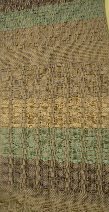
Cheryl Yetman created this shimmering and almost psychodelic bamboo shawl using a pattern from the Handweavers Pattern Directory. Everyone was and is completely mesmerized by the impact of the design. It's inspired other people in the class to recreate the same pattern.

INTERESTING LINKS AND OPPORTUNITIES
Carla Duncan writes: I have been looking for ideas about painted warp and found some images on this blog that helped give me ideas about the process. This may also be interesting to the other students taking the class.
http://lifeloomslarge.blogspot.com/2010/02/warp-painting-so-far-so-good.html

TASARA INTERNATIONAL WORKSHOP ON TEXTILE, 1 July to 15 August 2012
A residential workshop exploring a variety of weaving and surface-design techniques, in a secluded, family-run setting. Experience India's legendary monsoon season in a place with year-round mild temperatures on Kerala's green coast.

Techniques include handweaving, natural dyeing, shibori, multicolour batik, wood block printing, silk screen printing, felting, tie and dye, etc. Instruction will be provided 5 days a week, from 10 a.m. to 5 p.m. daily.

Four-week residencies are offered during the workshop session which will run from 1 July (Sunday) to 15 August (Wednesday) 2012. The fee for a four-week residency will be 900 Euros per person, double occupancy, or 1200 Euros single occupancy. The fee covers tuition and basic workshop materials, accommodation in a spacious guest house, and all meals, including breakfast and dinner of south Indian cooking and self-catered lunch.

For more information and to register, please contact by March._26th. Confirmation of your registration by payment of 50% of the fee will be due by _30th April.
Registration is limited to 10 participants
vasudevantasara@yahoo.com www.tasaraindia.com

FINAL NOTES:
  • If you are intending to return to the weaving classes for spring, please be sure to sign up if you have not already, especially if you have projects on the loom.
  • Last Monday class is March 19. The spring Monday class starts April 2 and the Wednesday class starts March 28. The classes run for 8 weeks.
  • The Painted Warp Off/On loom will start March 28 6-9pm.
  • The Field Trip to the City of Toronto Textile Archives will be on June 6 Wednesday at 10:30 am. There is limited space so please book your spot asap.
  • What to do when you've threaded your loom and you made a threading mistake and don't want to re-thread. A new items that I am excited about are clip on repair heddles  now available for both floor looms and table looms. They are $3 each.

Thursday, March 1, 2012

Weaving Challenges have something to teach us and the latest woven projects

Each weaving project  captures a certain period in our life. While we are preparing the warp threads, dressing the loom, weaving the item, countless thoughts, feelings and events travels through our mind. The woven project becomes almost a record of that period, whether through easy or challenging times, it is a testament to our lives, our perserverance and our hope. We learn in weaving, as in life, that if we work steadily through the frustrations, the disappointments, the challenges that each project brings to us, we will still produce something that others will certainly admire, eventhough we may not being having such kind thoughts about our work. The lessons we learn while weaving can very much be applied to our daily lives and relationships with ourselves and others.

Anne is featured above in front of her doubleweave afghan. She had many challenges with this. She was very enthusiastic about this wonderful hand dyed mohair yarn from New Zealand which she purchased when she was there for a few months. We discovered that doubleweave with sticky yarn/wool is not a good idea, and using a counterbalance made it even more challenging. The project started out with the intention of being a cape, and due to the challenges, Anne decided to make it a throw. Anne responded to last week's blog and said:  "Thank you for this wonderful posting. It was very meaningful to me, as is your wise friendship. I finished my blanket, and it looks really lovely. I have decided to give it to Phil, my husband, as his 60th birthday present. I will tell him how this weaving project is similar to our relationship - imperfect, difficult in the making, but beautiful, warm, and worth the effort. I wanted to give up on it, and I now so appreciate your heartfelt encouragement to persist and complete it......" What you have said here Anne, I know inspires us all!
Gert Rogers completed this afghan for her daughter in Lemieux 2 ply.  She is making another for another daugther. Gert asked me why I write the blog. It's easy for me because you, and each student, what they say, how they react, what they do, inspires me and I enjoy writing about and sharing what inspires me.

Registration for the Spring weaving classes has begun. Please register asap. At risk are the evening classes in particular, Monday evening. If you have a project on a loom and are intending to complete, please get your registration in immediately. Spring weaving classes start Wednesday March 28 and Monday April 2. The special course offered for Wednesday evening is Painted Warp off and on Loom. Registration for this is directly with me (Line Dufour).
We love the versatility and gratification we get from the 12" Ashford Knitters Loom. We can whip a project up quickly and satisfy our weaving cravings! This is Michelle Dubois' first knitters loom project. If you like small looms, check out the Ashford Katie Loom....an 8 harness sampler loom. http://www.ashford.co.nz/newsite/weaving-wheels-looms/102/weaving/katie-table-loom/moredetail.html . If you'd like to order it, I'll give you $50. off and free shipping as the special of the day.

What is nice about weaving with other people around you is the positive energy it creates. Janice has been working on her family tartan blanket and another student left her a lovely and admiring note. Kate sent me an email saying : "I have really enjoyed this weaving that I am working on. And it is nice to just be working away back there and kind of listening to conversations. Last week a lot of people stopped by to see how my little weaving was going. That was very nice of them." We should have a picture of Kate's latest 'postcard' series soon.

Lynne Wilson-Orr just finished her tapestry sampler. This photograph does it no justice. She's off this spring to learn tapestry weaving with Maximo Laura in Peru. If you think you'd be interested in such an adventure go to : http://www.puchkaperu.com/. Debbie Harris has already been and loved it. Judite Vagners is also going, another weaver who regularly attends our classes.

LINKS YOU SEND ME
Weaving in nature video sent to us by Rose Ruffolo: http://www.snotr.com/video/7331/The_Living_Bridge. You never know just how well your weaving skills might might save the day!

Cheryl Kerfoot sent me this link about miniature weaving. There is a big market for well made miniature handwoven items for doll houses. http://www.weevings.com/. Cheryl has taken classes with this person.

See you next week!


Friday, February 24, 2012

Learning Approaches and your weaving

Gwen Tooth chose the colours for her painting which she will interpret into a tapestry.

Each of us has our own preferred strategy of how we go about learning. Teachers colloege taught me that there are seven different learning modalities. I've always thought that my approach to learning was more radical than most, not taking well to following instructions. I prefer to use my intuition, a sensing approach to my learning. I have inclinations sometimes to defy the rules and want to make my own. Perhaps I even became a teacher not so much because I like telling people what to do but more because I don't like being told what to do. To my dismay, I have found that I learn best by being in a position where I must teach others. Gwen's painting and tapestry that will follow is a good example of the feeling and sensing approach. I say this because every now and then there is a student in the class who has a similar approach and want to put them at ease about it.

Rag rug by Agota Dolinay

As a learner in weaving I need to explore the possibilities. I need to ask myself 'what if'. I need to take risks, willing to allow things to go wrong, even fail. Each approach to learning has its advantages and disadvantages. In my case, if I had listened to what I was told in terms of rules, or read the instructions more carefully, I could have avoided some mistakes and problems, but these are all relative and depend on what outcomes you are seeking, the direction one is trying to steer oneself in. Why take this approach then? For me its very freeing allowing me to access my creativity and connects me with inspiration. Or perhaps too, its the inspiration that I am lead by first, and then I work out the details, experimenting and discovering, what works and what doesn't. This natural dyed cotton band by Leslie is a perfect example of all that I've said. Leslie challenges what I said was the 'right' way to prepare her project for weaving and she is discovering what works for herself, by challenging my advice. Leslie too likes to follow the impulse of her inspiration. Leslie dyed this on her own experimenting with different food items in her kitchen. Recently Leslie made a warp of 8/2 bamboo, a fairly fine yarn. She forgot to put the cross in it, which as many know is one of the things one should NEVER forget. I declared outright to Leslie that I WOULD NOT help her put it on the loom. I have to applaud Leslie for doing a very fine job indeed in getting this warp on the loom! Good going Leslie! Marion Kirkwood created this runner as a gift for the leaders of her trip to South Africa, who grew up there. She used 4/8 cotton, sleyed at 24 epi. The colours are those of the South African flag, stripes of blue, green, red, yellow and white, with the warp in black threading - twill, reverse twill, point twill, rosepath, reverse rosepath and basket, inspired from a baby blanket pattern from Handwove. The various patterns are designed to represent the diversity of South African society. Chenille scarves by Elaine Robertson

Some learners follow instructions precisely. Often their outcomes are exactly what they expected which is what the need and want. Some learners are fearless, taking on incredible challenges rapidly either technically or creatively. Others are careful, slow and methodical. Some learn best by themself in quiet moments. Others need lots going on. Learning and understanding how we learn is fascinating.


Undulating twill Alpaca shawl in beige and blue by Susan Abrams
What I've concluded after observing peoles different approaches, is that we learn best when we mix the approach we usually take with some of the approaches others take. I know for me it sometimes is outside my comfort level but I will still try and try and try to learn in different ways. I practice trying to follow instructions more carefully, more precisely. I am motivated to do this because I want to help my students with what they are trying to learn.


Detail of sampling for undulating twill in alpaca by Susan Abrams.
Above all, I try to let people learn in the way that works for the. The information and and experience won't happen any other way.

I am thrilled these days to see how the students in the class have been really evolving, growing in their weaving forays. In the next few photographs I wanted to highlight all the sampling people in the class have been doing. For instance above, Neil Brochu made a sample before embarking on making a line linen tablecloth, 60" x 72". The pattern he chose was a Lozenge twill from the book Keep me Warm one Night by Dorothy Burnham, a highly regarded historical book on textiles in Ontario.


Jill has struggled for almost two semesters to create this sampling for a rug she wants to create. I'm really proud of how she has figured out how to visualize what aspects of the sample she wants to incorporate into her final design. The limitation she set herself was to use the particular yarn she had bought on cones and choose the yarn based on colour and quantity.

Other samples being woven are the double weave sample by Cassandra Morton. Cassandra told me she was at a lecture at the University of Toronto in January where she is studying and the professor put up a You Tube video of me weaving tapestry! We were both surprised!
I've also been introducing students, when they start thinking of wanting to change a pattern, to software that will help them do it. Here Agota shows her own version of a huck design.


A number of people have woven huck samples and its remarkable how they differ from person to person. I had to show Lindsey's huck sample. Usually the huck sample requires using only one colour....which is how its been done traditionally. Lindsey needed to explore trying others colour with it, as did a number of other people in the class.


I work hard to respect and honour each persons learning style, while at the same time encouraging them to venture into and try other strategies...to stretch our muscles so to speak. They'll discover that practicing a different approach sometimes can be very rewarding and satisfying, as I have, learning to follow instructions. Carol Adams wrote me recently in response to my last blog and said: "Thank you for keeping me in the circle. I very much enjoyed viewing the work of your students from last semester. And I will miss not being with you in the Spring.
But this time, even more, your writing about the class has stayed with me. I hope your students learned to use the mat at the door. If they didn't, then the atmosphere you create in the class room with the soothing classical music from CBC, and the easy way you move around from one loom to the next, and your own personal quietness all have their own positive influence.
And then there is the loom. No matter what size, it requires you to put everything else aside and pay very close attention to it. My weaving has been and continues to be a refreshing experience for which I am very grateful.

At present, I am dressing my loom with a 100% silk yarn to make curtain material for the windows on my stair landing. My pattern is again the LeClerc placemat but I have changed from the Indigo and Gold, Lt Blue and Wine to Cream and Gold, Ecru and Apple Green. The placemats called for 36 epi; however with the silk, I am using 18 epi and as long as it is even I won't mind a bit of light coming through.

Line, I miss you and the collegiality of the class and you are often in my thoughts." Thank you Carol!


Huck sample by Jane Tucker.

I guess after all this I'm just trying to say there is no right or wrong way to learn. We all have our own unique combination of approaches and we have to work with that.


I'm ending with this table runner woven by Janet Andrews. She wove this for her parents. Although there were a number of threading errors in the pattern, Janet still was delighted with her efforts. I love it when people can laugh at their mistakes, plunders, false starts....as we must have a good laugh at ourselves sometimes and still think that what we have just done is still praiseworthy and good. As one weaving clas tapestry weaver, Pauline Abraham said, "I'm practicing the art of imperfection". Here's to imperfection! Cheers!

Friday, January 27, 2012

Notes and card weaving

Mimma Draga has been taking notes since starting to learn how to weave in my class. One day I happened to glance at them, and I couldn't help but think of the great Leonardo and his illustrations. Very detailed and wonderful illustrations. For most of us, our notes don't look anything like this, if we have any at all. Which brings me to the topic of learning and how we learn. One of the most useful things I learned at teachers college is that there are 7 different modalities of learning. Essentially, they comprehend all our senses, mixed in with how we process information best. For each us that equation is different and proceeds at different rates as we process the information, and it eventually becomes 'automatic'. This is helpful to know so that one doesn't berate oneself for not absorbing knowledge and technique as quickly as one would like. It's almost as if the body has to learn it too, and not just the mind. I guess this is why Malcolm Gladwell says that it takes 10,000 hours to achieve mastery at something. Do you realize that you would have to do something 24/7 for over 27 years? It's probably best to just enjoy the activity, the process and company while you are doing it!


During our Fall classes, some students became interested in card weaving. Judite has been doing it since childhood and gladly showed Judy, Leslie and Wendy how it worked.


She made up the cards for them, brought the thread. Gave them a demo of the process.


And this is what they were trying to weave with the card weaving process. One can learn from books. One can learn from videos. But there is nothing like learning from another person who is there physically beside you while you fumble your way through the project and calms all your fears and doubts in yourself and your abilities. Thank you Judite for showing them how it works.


See you next week!


Thursday, January 19, 2012

Encouraging authentic creativity in weaving

I feel blessed indeed that my weaving students are such intelligent, interesting and engaging people. They are talented, and take creative approaches not only in their weaving, but in the way they learn too. This past Fall was very busy and I didn't get a chance to post all the wonderful projects that resulted over the course of student efforts. Since there are quite a few things to show y'all, I'll start with the products of the most recent participants in the weaving class and will show the remaining projects and endeavours at other times. Above, a tapestry by Clara.
As an instructor, I encourage students to develop their own designs and creativity. I teach them strategies, if they are open to it, to enhance and deepen their creative experience. Everyone comes with their own knowledge, experience and approach and this only makes for a more authentic result in their creative endeavours. Ciara is shown here with her first tapestry (after that gruelling sampler!) that she designed. It was inspired by wood.
Christine Davidson's runner above, is a good example of how some students prefer to take their inspiration from such sources as Handwoven magazine, a good place to expand one's repertoire, creatively, theoretically and technically.
Some participants are very modest about their efforts and I'm happy to put in them in the spotlight. I also applaud those who are endeavouring to set up a loom at home without me to help them out. As many of you know or can remember, it can be a daunting experience just even remembering all the steps and details one needs to consider. Though the photo does not do this blanket any justice, it was woven by Jane Tucker.


This red and fuschia merino scarf was woven by Wendy Szpindel who managed to do this over the Holiday Season on her own. I suppose its like seeing a child take its first steps! So exciting.


This week we've moved forwards with preparing our warps (and wefts possibly) for ikat dyeing. In the coming weeks we'll be preparing warps for painted warp, shibori and woven shibori.


See you soon!

Thursday, October 27, 2011

Return to weaving classes

The summer was busy for me because I received a grant from the Ontario Arts council to collaborate with the Nottawasaga Handweavers and Spinners to design and launch the weaving of 12 tapestries depicting the community of New Tecuseth. I invited this guild to join me at the opening reception of my own solo exhibtion of tapestries entitled Wholeness, and to officially launch the Community Threads tapestry project. The tapestries will be woven by guild members, visitors, guests, and members of other organizations and institutions over the coming years. When the tapestries are completed, a self guided tour brochure will assist visitors in seeing the tapestries at different venues in the municipality. The picture above shows a part of my more recent tapestries at this exhibit.


Our weaving class is definitely the 'happy place' for many of us. I couldn't resist taking this picture this week as there was a full line up of table loom weavers. From left to right, Mimma, Justine, Jane, Phyllis, Sandi, Agota and Emily at the back who just started with us this week.


To help everyone figure out what they'd like to learn in weaving, I've created a Weaving Menu, listing all the kinds of things you can learn about weaving. Ask me for a copy if you are interested in expanding your repertoire and understanding of weaving.


Many of the returning students completed projects over the summer. In this photo, a beautiful shawl woven by Agota Dolinay. She used 18/2 merino for warp and some very fine yarn from Habu in the weft. The pattern was one that most have overlooked and taken from The Handweavers Pattern Book (Davison). Its called Indian March and is on page 38. There is so much going on in it.


Anther finished project....this 2/8 cotton scarf in M's and O's by Mimma Draga. This is Mimma's first project and her edges are near impeccable. She is definitely a natural born weaver.


Wendy Szpindel came back eager to share her summer projects. She explored an undulating twill which we clearly see in the white piece. In the foreground, is a study of using variations with colour and treadling with the same threading. A very good study indeed. Wendy and her sister Leslie seem to be going in the direction of creating wall hangings.


This week Sandi Dunn came in wearing a Halloween outfit. I applaud her fearlessness! She is wearing a fascinator by David Dunkley who is a millner in Toronto and has a shop at 998 Bathurst Street. The business is called KC Hats.


A couple of our weaving class participants have exhibitions on or about to occur: Beth Stewart at ESP Gallery at Dovercourt and Queen, who is a winner of an RBC prize of $15,000, and who is teaching drawing at OCAD and Gwen Tooth at the beaux-arts brampton from November 1 to 26.


Tuesday, June 7, 2011

Precious

When seeing the work of the weaver Judith Fielder, precious is the first word that comes to mind. As I look in the dictionary to see how it is defined, I stumble upon the word that precedes it: preciosity and the dictionary I'm using defines this as "fastidious refinement". This is certainly an apt description of Judith Fielder's body of work. Taken by Debbie Harris, this photograph
gives you a feel of how the morning began - very casually but it was clear that Judith had done a lot of preparation to receive us and share her treasure trove of exquisite work. She had 3 main bodies of work. They were each layed out on a different floor in the house. On the first floor in the living room, she had her earliest work, with notebooks, sketches, inspirations as well as finished garments. Here the influence of African textiles was predominant. On the second floor, her forays into overshot where we saw a jacket, scarf and dress that she created. Below is the fabric of the jacket that has been featured in Fibre Focus and Handwoven magazine in the 90s.

I first met Judith at the Ontario College of Art in the 80s (and Design University) and have known her for many years. Her endeavours have never failed to have a certain fascination for me. At art college, it was hammered into us to create studies, samples, experiment and explore the endless possibilities and potential of an idea. Judith's notebooks illustrated this methodology well.


Several of us took many pictures of the talk and studio visit and there are just too many worthy pictures to post on the blog so I will put only a few here to arouse your curiousity and awe about her work and the remainder I will put on a cd and have it available in the weaving class so that you can look at her work at your leisure. This picture is of Susan Abrams modelling a shawl handwoven and hand embroidered on the loom.


Judith has also had a thing for blankets over the years. Again they reflect whatever weave structure or textile embellishment she happens to be investigating as well as the art or cultural influence. In this particularly spectacular blanket the squares alternate between overshot blocks and hand embroidered motifs that keep recurring in her work.


On the third floor, which she uses entirely for her studio, one feels the magic of her creative sanctuary. Just being there is almost a religious experience. On this floor are her explorations into shibori as well as kumihimo that you see laid out here. It's clear by the end of the visit that one of the main characteristics of Judith's work is its multicultural influences that have always been there from the beginning of her weaving forays. She is also curious about experimenting with different kinds of fibres - notably, all of a certain quality and refinement. In addition, she aims for a certain level of excellence in her weaving that we all found breath taking. All of us that attended the studio visit on May 25 were awe struck the entire 3 hours of the visit, and felt the impact of this for days afters. We only wish the rest of you could have been so blessed and honoured to visit this wonderful weaver.

In the coming weeks I'll be featuring all the great projects that came off the loom this spring! Stay posted!