 Gwen Tooth chose the colours for her painting which she will interpret into a tapestry.
Each of us has our own preferred strategy of how we go about learning. Teachers colloege taught me that there are seven different learning modalities. I've always thought that my approach to learning was more radical than most, not taking well to following instructions. I prefer to use my intuition, a sensing approach to my learning. I have inclinations sometimes to defy the rules and want to make my own. Perhaps I even became a teacher not so much because I like telling people what to do but more because I don't like being told what to do. To my dismay, I have found that I learn best by being in a position where I must teach others. Gwen's painting and tapestry that will follow is a good example of the feeling and sensing approach. I say this because every now and then there is a student in the class who has a similar approach and want to put them at ease about it.


Rag rug by Agota Dolinay
As a learner in weaving I need to explore the possibilities. I need to ask myself 'what if'. I need to take risks, willing to allow things to go wrong, even fail. Each approach to learning has its advantages and disadvantages. In my case, if I had listened to what I was told in terms of rules, or read the instructions more carefully, I could have avoided some mistakes and problems, but these are all relative and depend on what outcomes you are seeking, the direction one is trying to steer oneself in. Why take this approach then? For me its very freeing allowing me to access my creativity and connects me with inspiration. Or perhaps too, its the inspiration that I am lead by first, and then I work out the details, experimenting and discovering, what works and what doesn't.  This natural dyed cotton band by Leslie is a perfect example of all that I've said. Leslie challenges what I said was the 'right' way to prepare her project for weaving and she is discovering what works for herself, by challenging my advice. Leslie too likes to follow the impulse of her inspiration. Leslie dyed this on her own experimenting with different food items in her kitchen. Recently Leslie made a warp of 8/2 bamboo, a fairly fine yarn. She forgot to put the cross in it, which as many know is one of the things one should NEVER forget. I declared outright to Leslie that I WOULD NOT help her put it on the loom. I have to applaud Leslie for doing a very fine job indeed in getting this warp on the loom! Good going Leslie!
 Marion Kirkwood created this runner as a gift for the leaders of her trip to South Africa, who grew up there. She used 4/8 cotton, sleyed at 24 epi. The colours are those of the South African flag, stripes of blue, green, red, yellow and white, with the warp in black threading - twill, reverse twill, point twill, rosepath, reverse rosepath and basket, inspired from a baby blanket pattern from Handwove. The various patterns are designed to represent the diversity of South African society.
  Chenille scarves by Elaine Robertson
 This natural dyed cotton band by Leslie is a perfect example of all that I've said. Leslie challenges what I said was the 'right' way to prepare her project for weaving and she is discovering what works for herself, by challenging my advice. Leslie too likes to follow the impulse of her inspiration. Leslie dyed this on her own experimenting with different food items in her kitchen. Recently Leslie made a warp of 8/2 bamboo, a fairly fine yarn. She forgot to put the cross in it, which as many know is one of the things one should NEVER forget. I declared outright to Leslie that I WOULD NOT help her put it on the loom. I have to applaud Leslie for doing a very fine job indeed in getting this warp on the loom! Good going Leslie!
 Marion Kirkwood created this runner as a gift for the leaders of her trip to South Africa, who grew up there. She used 4/8 cotton, sleyed at 24 epi. The colours are those of the South African flag, stripes of blue, green, red, yellow and white, with the warp in black threading - twill, reverse twill, point twill, rosepath, reverse rosepath and basket, inspired from a baby blanket pattern from Handwove. The various patterns are designed to represent the diversity of South African society.
  Chenille scarves by Elaine Robertson
Some learners follow instructions precisely. Often their outcomes are exactly what they expected which is what the need and want. Some learners are fearless, taking on incredible challenges rapidly either technically or creatively. Others are careful, slow and methodical. Some learn best by themself in quiet moments. Others need lots going on. Learning and understanding how we learn is fascinating.
 Undulating twill Alpaca shawl in beige and blue by Susan Abrams
  Detail of sampling for undulating twill in alpaca by Susan Abrams.
  I am thrilled these days to see how the students in the class have been really evolving, growing in their weaving forays. In the next few photographs I wanted to highlight all the sampling people in the class have been doing. For instance above, Neil Brochu made a sample before embarking on making a line linen tablecloth, 60" x 72". The pattern he chose was a Lozenge twill from the book Keep me Warm one Night by Dorothy Burnham, a highly regarded historical book on textiles in Ontario.
 Jill has struggled for almost two semesters to create this sampling for a rug she wants to create. I'm really proud of how she has figured out how to visualize what aspects of the sample she wants to incorporate into her final design. The limitation she set herself was to use the particular yarn she had bought on cones and choose the yarn based on colour and quantity.
 Other samples being woven are the double weave sample by Cassandra Morton. Cassandra told me she was at a lecture at the University of Toronto in January where she is studying and the professor put up a You Tube video of me weaving tapestry! We were both surprised!
 I've also been introducing students, when they start thinking of wanting to change a pattern, to software that will help them do it. Here Agota shows her own version of a huck design.
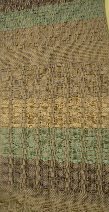 A number of people have woven huck samples and its remarkable how they differ from person to person. I had to show Lindsey's huck sample. Usually the huck sample requires using only one colour....which is how its been done traditionally. Lindsey needed to explore trying others colour with it, as did a number of other people in the class.
 I work hard to respect and honour each persons learning style, while at the same time encouraging them to venture into and try other strategies...to stretch our muscles so to speak. They'll discover that practicing a different approach sometimes can be very rewarding and satisfying, as I have, learning to follow instructions. Carol Adams wrote me recently in response to my last blog and said: "Thank you for keeping me in the circle. I very much enjoyed viewing the work of your students from last semester. And I will miss not being with you in the Spring.
But this time, even more, your writing about the class has stayed with me. I hope your students learned to use the mat at the door. If they didn't, then the atmosphere you create in the class room with the soothing classical music from CBC, and the easy way you move around from one loom to the next, and your own personal quietness all have their own positive influence.
And then there is the loom. No matter what size, it requires you to put everything else aside and pay very close attention to it. My weaving has been and continues to be a refreshing experience for which I am very grateful.
At present, I am dressing my loom with a 100% silk yarn to make curtain material for the windows on my stair landing. My pattern is again the LeClerc placemat but I have changed from the Indigo and Gold, Lt Blue and Wine to Cream and Gold, Ecru and Apple Green. The placemats called for 36 epi; however with the silk, I am using 18 epi and as long as it is even I won't mind a bit of light coming through.
Line, I miss you and the collegiality of the class and you are often in my thoughts." Thank you Carol!
 Huck sample by Jane Tucker.
 I guess after all this I'm just trying to say there is no right or wrong way to learn. We all have our own unique combination of approaches and we have to work with that.
 I'm ending with this table runner woven by Janet Andrews. She wove this for her parents. Although there were a number of threading errors in the pattern, Janet still was delighted with her efforts. I love it when people can laugh at their mistakes, plunders, false starts....as we must have a good laugh at ourselves sometimes and still think that what we have just done is still praiseworthy and good. As one weaving clas tapestry weaver, Pauline Abraham said, "I'm practicing the art of imperfection". Here's to imperfection! Cheers!
 I'm ending with this table runner woven by Janet Andrews. She wove this for her parents. Although there were a number of threading errors in the pattern, Janet still was delighted with her efforts. I love it when people can laugh at their mistakes, plunders, false starts....as we must have a good laugh at ourselves sometimes and still think that what we have just done is still praiseworthy and good. As one weaving clas tapestry weaver, Pauline Abraham said, "I'm practicing the art of imperfection". Here's to imperfection! Cheers!


